
Disasters At Sea: The Santa Barbara Oil Spill of 1969
- Emily Eliese Cohen
- Apr 23
- 5 min read
The ocean faces many threats from pollution to climate change. In this new series “Disasters at Sea” we will be covering environmental disasters and their effects on marine systems. In this, the first article of the series, we're covering one infamous environmental disaster that sparked the beginning of the environmental movement of the 1970s and led to the creation of America’s first Earth Day: the Santa Barbara oil spill of 1969.
The Disaster: The Santa Barbara Oil Spill of 1969

On January 28th, 1969 at 10:45am, an oil rig five miles off the coast of Santa Barbara, California blew out. The rig, platform Alpha, was operated by Union Oil and on the day of the spill, pipe was being extracted from a 3,500 foot deep well. During this extraction, pressure increased on the casing of the upper well and was not compensated for properly with drilling mud. An emergency attempt to cap the burst only succeeded in increasing the pressure within the well, leading to an explosive burst of natural gas that not only split the casing but also created cracks along the seafloor.
From the time the well burst and the seafloor cracked until the spill was eventually contained, three million gallons (80,000 to 100,000 barrels) of crude oil spewed into the Pacific Ocean. After eleven days the well was capped, but by then the oil had spread to over 800 square miles of ocean and some oil continued to seep from between seafloor cracks for several weeks. Between Santa Barbara and Ventura, 35 miles of coastline were coated in oil up to six inches thick.
The Impact

For the marine life living in the contaminated zone, the spill was catastrophic. 3,600 seabirds died, washed ashore alongside numerous marine mammals from dolphins to sea lions and elephant seals. Oil clogged the blowholes of cetaceans. Intertidal organisms suffered an estimated 80-90% mortality rate.
The Santa Barbara Channel is considered a biodiversity hotspot as it hosts a thriving marine ecosystem with numerous endemic species of fish, seabirds, marine mammals, and plant life. It is considered one of the most beautiful stretches of US coastline and has been referred to as the “American Riviera". As the oil spread and choked out the pristine landscape and wildlife, its devastation spurred outrage.
It was the largest oil spill in United States history at the time (third largest today). Its impact on marine life was monumental. Its impact on local communities, activists, and U.S. environmentalism was even bigger.
Recovery: The “Get Oil Out!” Movement / Birth of Earth Day
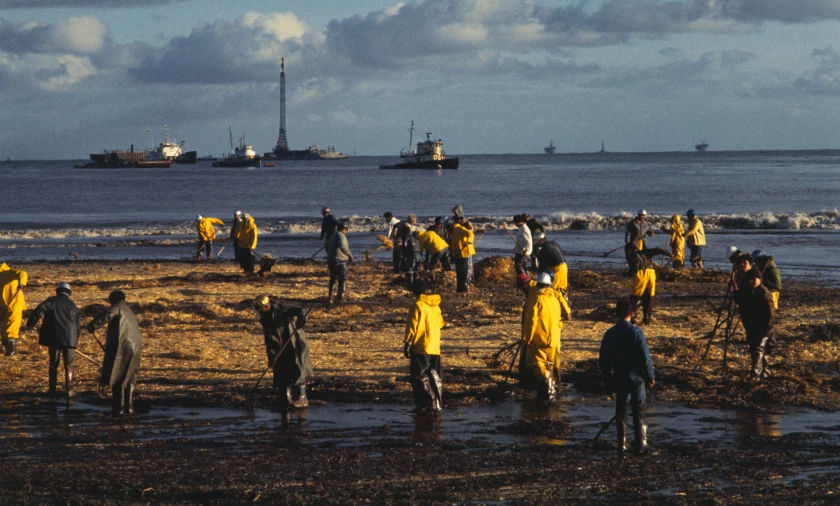
In the aftermath of the spill, local volunteers mobilized with cleanup efforts, wildlife rehabilitation, and environmental activism. 3,000 tons of straw soaked up oil along the shore while contaminated sand was trucked out of the area. Over 5,200 large dump truck loads were hauled away. From the ocean surface, skimmer ships removed layers of oil. Planes overhead dumped chemical dispersants and detergent over the sea to break up larger oil clumps.
Marine life washed ashore or found floating along the coast was cleaned and treated at temporarily established animal rescue stations to remove the contamination from their feathers and fur. These efforts were taken by people of all ages and backgrounds as Santa Barbarans jumped into action, their passion loud enough to reach the entire nation.
People took to the streets to push for stronger environmental safeguards that would prevent future similar disasters. Numerous environmental organizations were formed during this time, including the grassroots movement “GOO!” which stands for “Get Oil Out!”. They called for the end of offshore oil drilling in the Santa Barbara Channel. The Environmental Studies department at the University of California Santa Barbara was established the following year, one of the very first universities to have such a program.
Images of dying wildlife, silent black waves, and oil stained beaches spread in newspapers and televisions across the country. The disaster marked a tipping point in the public’s attitude toward the environment. As Silent Spring by Rachel Carson became a bestseller a few years earlier, as concerns over nuclear fallout and cancer risk increased, as discussions about herbicide and public health spread, the Santa Barbara oil spill catalyzed an already growing public concern.
President Nixon himself visited the scene, stating that “the Santa Barbara incident has frankly touched the conscience of the American people.” The Environmental Protection Agency was established the following year, and public pressure from the oil spill helped pass the Clean Air and Clean Water Acts in 1972. From this disaster at sea came a silver lining — a push for environmental protection at the national level.
Gaylord Nelson, a Wisconsin senator, also visited Santa Barbara during this time. The devastation he saw directly inspired his idea for a national “teach-in” on the environment. He felt that the youth’s activism towards social and political issues could be channeled toward preserving the natural world too. He selected April 22nd, a date convenient for students as it fell between Spring Break and finals, for the teach-in. In 1970, this teach-in became the first Earth Day and was celebrated by 20 million people demonstrating for environmental action.
Conclusion
This year marks the 56th Earth Day. It is an annual reminder of the interconnectivity between humanity and nature. The Santa Barbara oil spill of 1969 serves not only as a cautionary tale for what can occur when our natural world is disregarded as an afterthought, but it also serves as an inspiration for what can be accomplished when we take action to prioritize environmental and marine preservation.
Citations / Directories
Citation 1: “A Brief History of the Santa Barbara Oil Spill and Earth Day”, Written by Unknown, & Published at an Unknown Date. Published by the Santa Barbara Earth Day Festival.
Citation 2: “The Santa Barbara Oil Spill: A Retrospective”, Written by Keith C. Clarke, & Jeffery Hemphill, & Published in 2002. Published by the University of California, Santa Barbara.
Citation 3: “‘The Ocean Is Boiling’: The Complete Oral History of the 1969 Santa Barbara Oil Spill”, Written by Kate Wheeling & Max Ufberg, & published on April 18th, 2017. Published by Pacific Standard.
Citation 4: “Decades After the Oil Spill That Inspired Earth Day, Are We Prepared for the Next One?”, Published by Lindsay Key, & Published on April 21st, 2021. Published by Columbia University.
https://lamont.columbia.edu/news/decades-after-oil-spill-inspired-earth-day-are-we-prepared-next-one
Citation 5: “History of GOO!”, Written by Unknown, & Published at an Unknown Date. Published by Get Oil Out.
Citation 6: “How an Oil Spill Inspired the First Earth Day”, Written by Lila Thulin, & Published on April 22nd, 2019. Published by Smithsonian Magazine.
Citation 7: “Santa Barbara Oil Spill: 1969 California”, Written by Jack Doyle, & Published on February 22nd, 2016. Published by Pop History Dig.
Citation 8: “Our History”, Written by Unknown & Published at an Unknown date. Published by EarthDay.org.
Citation 9: “See the impacts of 1969 oil spill off the coast”, Written by Unknown, & Published on January 23rd, 2019. Published by the Ventura County Star.
Strategic Partnerships
Reel Guppy Outdoors
SharkedSkooler
Marine Enthusiasts Podcast
Cash Daniels
Tides of Tomorrow
The Open Book, Topanga
Olivenbaum Music
Pitfire Artisan Pizza
Our Loyal Patrons
P. R. Ochoa


Comments