
Disasters at Sea: Climate Change Affecting AMOC (Atlantic Meridional Overturning Circulation)

Introduction
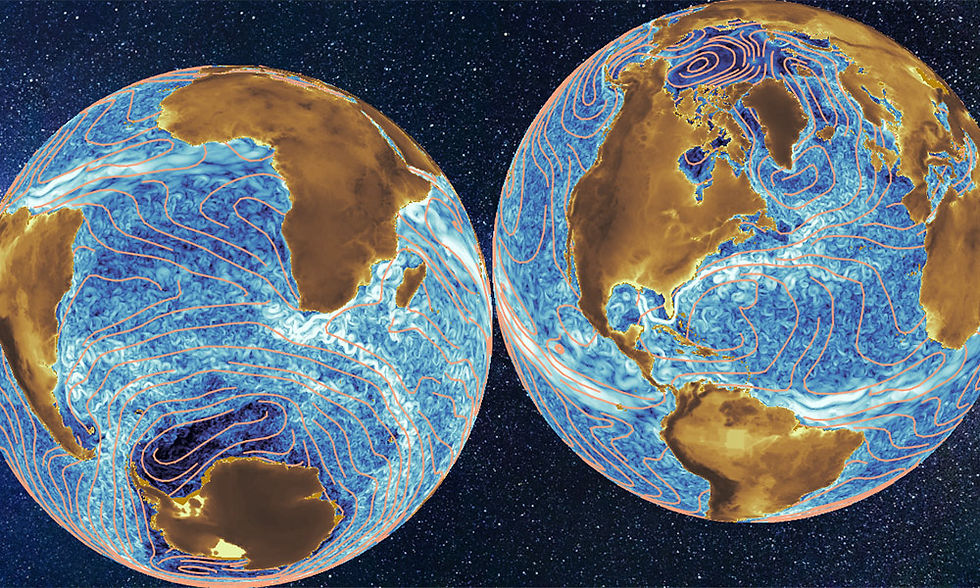
For thousands of years, ocean currents have flowed around the globe, influencing weather patterns and shaping ecosystems as they go. This global conveyor belt has a “motor” called the Atlantic Meridional Overturning Circulation (AMOC) that drives our currents, but climate change is weakening it. It may be surprising that global warming impacts ocean currents, but the warmer our planet gets, the more likely our dynamic ocean and weather patterns will shift. In this article we’ll explain what the AMOC is, how warming temperatures affect it, and what this means for ocean currents, people, and our planet.
The Disaster: A Weakening AMOC
To understand the implications of a weakening AMOC, it helps first to understand how our ocean currents normally function. Surface currents are driven primarily by wind while deeper currents are driven by salinity and temperature. Both of these factors can influence the density of water which creates the pressure changes that drive deeper currents. This is known as thermohaline circulation.
Because of these influences, our ocean currents are able to travel around the planet, bringing water from the equator to the poles and back. The Atlantic Meridional Overturning Circulation specifically refers to the system of currents in the Atlantic Ocean that carries warm equatorial water northward and colder water southward.

Let’s pretend you are a water molecule floating through the AMOC system. We’ll start along the equator. Here you are warmed up by the intense equatorial sunlight. As you float northward, you are picked up by the Gulf Stream, a strong ocean current leading you upward along the coasts of the Americas. Every second, 17 million cubic meters of seawater is carried northward by the AMOC (an equivalent of 6,800 Olympic swimming pools!)
The Gulf Stream carries you farther away from the heat of the equator and you eventually begin to cool. By the time you reach the North Atlantic, you’ve become much, much colder. In fact, it is so cold that the water around you freezes into sea ice. As this sea ice forms, salt is left behind and the salinity of the ocean water increases. Compared to where you started, the ocean is now both colder and saltier, and both of these characteristics make the water denser.
Denser water sinks. You begin to rapidly drop toward the bottom of the ocean. This sinking is incredibly powerful, and it drives the AMOC cycle, acting as a motor to the ocean current system.
As you float down, you also travel back southward where you will eventually resurface near the equator in a process known as upwelling. Upwelling brings nutrients from the deep sea to the surface, which helps support marine life. When you surface, you are warm again and ready to continue traveling the globe. All ocean currents are connected, and the AMOC (particularly the sinking in the North Atlantic) is powerful enough to drive the flow of water around the planet.
The AMOC allows for the transfer of heat from the equator northward which helps regulate the weather in Europe, keeping it from freezing over despite its high latitude. But climate change threatens to shut the whole system down.
With rising temperatures, the water in the North Atlantic is becoming less dense. This is both because warmer water is inherently less dense and because it is now too warm for the sea ice to form. Additionally, melting ice and increased rainfall are adding back more freshwater. The combination leads to less salty and therefore less dense water. Without dense water to rapidly sink, the motor of the AMOC is slowing down and threatening to disrupt ocean currents everywhere.
The Impact
Some data suggests the AMOC has already slowed down by as much as 15% since 1950. So what happens if the AMOC shuts down entirely?
Without the AMOC, Europe would no longer receive the extra heat from the equator that the AMOC provides. This would make for much colder winters. Additionally, the climate is a very fragile and interconnected system, so while Europe would be the most directly affected, these changes would also impact weather patterns globally. An AMOC collapse could affect the Indian monsoon season and create droughts in parts of Africa. It could also increase sea level rise on the East Coast of the US and affect rainy/dry seasons in the Amazon, etc.

Recovery / Conclusion
The AMOC collapse is an example of a climate “tipping point”, meaning that it would have massive repercussions and would be nearly impossible to reverse. While research has not yet determined how soon or how certain that collapse might be, it is clear that the AMOC is slowing down, and even a little bit of that weakening could have serious implications.
That’s why it is important that we take immediate action to slow emissions, curb climate change, and avoid it altogether. In order to keep our ocean currents and our weather patterns stable, we need to protect the AMOC and avoid another disaster at sea.
Citations / Directories
Citation No. 1: “Effects of Climate Change”, Written by Unknown, Published on Unknown Date. Published by NOAA. Retrieval Date: August 30th, 2026 https://oceanservice.noaa.gov/education/tutorial_currents/05conveyor3.html
Citation No. 2: “Oceans Explained AMOC”, Written by Unknown, Published on Unknown Date. Published by National Oceanography Centre. Retrieval Date: September 1st, 2026 https://www.noc.ac.uk/discover-the-ocean/oceans-explained/the-atlantic-meridional-overturning-circulation
Citation No. 3: “ What is the Atlantic Meridional Overturning Circulation (AMOC)?”, Written by Unknown, Published on Unknown Date. Published by NOAA. Retrieval Date: September 8th, 2026 https://oceanservice.noaa.gov/facts/amoc.html
Citation No. 4: “What would happen if the Atlantic Meridional Overturning Circulation (AMOC) Collapses? How likely is it?”, Written by MIT Climate Portal Writing team, Published on November 7th, 2024. Published by Climate Portal. Retrieval Date: September 9th, 2026 https://climate.mit.edu/ask-mit/what-would-happen-if-atlantic-meridional-overturning-circulation-amoc-collapses-how-likely
Citation No. 5: “What is the Atlantic Meridional Overturning Circulation (AMOC)?”, Written by Unknown, Published on Unknown Date. Published by NOAA. Retrieval Date: September 9th, 2026 https://oceanservice.noaa.gov/facts/amoc.html
Strategic Partnerships
Reel Guppy Outdoors
SharkedSkooler
Marine Enthusiasts Podcast
Cash Daniels
Tides of Tomorrow
The Open Book, Topanga
Olivenbaum Music
Pitfire Artisan Pizza
Three J’s Kitchen
Presence News
Our Loyal Patrons
P. R. Ochoa


Comments