
Marine Biological Hall of Distinction: Dr. Robert Kent Trench

Updated: Apr 27

This article is part of our Marine Hall of Distinction collection. In this special collection, we discuss the marine biologists who have contributed most to marine biology & oceanography. We do this to commemorate these marine biologists & show gratitude for everything they have contributed to our oceans. Today's marine scientist is Dr. Robert Kent Trench.
Dr. Robert Kent Trench was the leading expert on coral reefs and their symbiotic relationship with Zooxanthellae algae, discovering chemical compound conversions and algal universes. Trench was one of the first black men to become a trailblazing Marine Biologist, and his work serves as the foundation for much of today’s marine biological studies.
In today’s article, we will delve into his formative years & education, his personal life & career, as well as his achievements, awards, & accomplishments. With that being said, let’s plunge into the extraordinary life of Dr. Robert Kent Trench and coral reefs!
His Education & Formative Years
Belize City, the largest city in the former British Honduras now Belize; was a bustling seaport colonial city in 1940 famous for its sparkling clear waters of the Caribbean gulf and its diverse sea life – especially coral reefs - making it a paradise for both residents and scientists. It was here that the future trailblazing Marine Biologist and coral reef expert Robert Kent Trench was born on a warm, late summer day August 3, 1940. While Trench was still a school boy, his parents departed Belize for a new life in America leaving Trench under the tutelage of his grandmother who lived seaside parallel to the Belize Barrier Reef: the largest coral reef in the Northern Hemisphere at a massive 190-miles long. Trench would spend hours on end making the sea his sole companion investigating the glorious reefs and sparking the fire of his future career, then unknown to him.
As the calendar years flipped, Trench left childhood behind and attended the Jesuit High School in Belize City known for its science academic program. Here, Trench was able to formally study the ocean, sea life and discourse on coral reefs to anyone and everyone who would listen. With his mind enticed to learn more about the sea ecosystem and having excelled in high school; Trench entered the newly formed University of West Indies (Jamaica campus) receiving his undergraduate degree. While at UWI, Trench’s passion and knowledge garnered attention from experts in the field and he was asked to join the elite coral reef research team of Tom and Nora Goreau, the pioneers of coral reef study. Alongside Tom and Nora, Trench explored the symbiotic relationships critical to coral reef skeletal formation and overall growth. Trench felt there must be a symbiosis between algae and coral and made this his central study focus from herein.

Trench was fully immersed in marine biology and knew that his future depended on the same move his parents made so many years prior and thus moved to the United Sates – specifically to Los Angeles, California to study invertebrate zoology at the University of California, Los Angeles (UCLA) earning his doctorate in 1969. It was during his time at UCLA that Trench earmarked the field of dissecting the biochemical compounds transferred from algae to coral during their symbiosis for which Trench would make marine biological history and led to a post-doctoral fellowship at the world-renowned University of Oxford in Oxford, England.
His Personal Life & Career
During his doctorate studies at UCLA’s Leonard Muscatine’s oceanic lab; Trench and Muscatine focused on the biochemical symbiotic conversion between coral and algae which became the focus of Trench’s thesis and his subsequent specialization in Zooxanthellae. Trench discovered that algae use the protection provided by coral while in turn, the algae displace its photosynthesized energy to the coral with both acting as hosts to the other versus a parasitic, one-sided relationship. Trench mastered these histological techniques to reveal species of algae-within-algae and multiple chromosomes; discovering an entirely new biodiverse universe. This discovery made Trench the leading expert in zooxanthellae and led to his role as an assistant professor at Yale for four years. During this time, Trench’s first contribution to marine biology was published in, Nature (having been declined initially by Science) on the subject of photosynthetic animals; raising his popularity in the field and promoting his transfer to the University of California, Santa Barbara as a professor in the Department of Ecology, Evolution and Marine Biology.
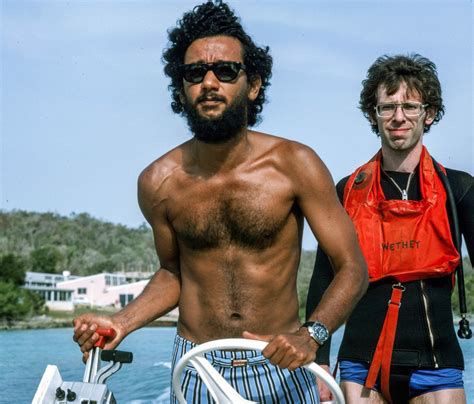
Students enrolled in Trench’s coursework enjoyed unlimited access to peruse their own scientific hypothesis as Trench strongly eschewed from concrete constructs whether in the lab or field. Trench and his students explored and studied symbiotic relationships in multiple global locales including Hawaii, Jamaica, Mexico, Palau and Eniwetok Atoll; while also exploring the effects of temperature changes (now known as global warming) on coral bleaching. His method of teaching future marine biologists included the encouragement of proposing endless questions and living by the motto, “I want to teach them how to learn on their own, so that I become irrelevant.”
Despite Trench’s many discoveries and revelations; he was often overlooked and did not receive his fair share of credit which was instead given to those who ‘re-discovered’ his findings. Some of this reasoning was due to his own penchant for solitude and disdain for fame. Trench was known by his colleagues as “the nicest guy” but was a straight-shooter, often proved others’ theories as false and wasn’t afraid of a healthy debate which created some contempt from those who disliked this direct approach.
The unfortunate effects of racism impacted Trench’s career as some saw the color of his skin over the monumental influence of his work. Trench was overlooked for the role of the Director of the Discovery Bay Marine Lab from the consensus that a “blackie wasn’t acceptable”; and other distinguished positions and grants in favor of those with more Aryan backgrounds. Other programs hired him merely as their “token black man”. Although excuses were often placed that Trench was too young, too interdisciplinary, too broad for funding, etc.; the reasoning was solely due to the factor of race. While teaching at UCSB, Trench was often confronted by university campus security for not looking “like he belonged on campus”. Trench was quoted as saying, “No matter what I do, to some people I will always just be a n –.” It is this racism that directly led to his early retirement in 2000.
Trench published numerous papers and laid groundbreaking discovery foundations which are still being studied today and impact the current field of coral restoration completely changing the entire scope of marine biology. In 1994, Trench was honored with the Miescher-Ishida Prize for his pioneering work regarding the metabolite flux from kleptochloroplasts.
When not dissolved in marine biology, Trench enjoyed history - particularly the American Civil War, fishing, boating, woodworking (even making furniture) and collecting coral skeletons. Trench passed only a year after his retirement on April 27, 2021 from undisclosed causes.

His Awards, Accomplishments & Achievements
1. He was given an award by Queen Elizabeth II to study the Great Barrier Reef in Australia.
2. In 1994, Trench was honored with the Miescher-Ishida Prize for his pioneering work regarding the metabolite flux from kleptochloroplasts.
3. He was awarded the Healthy Reefs for Healthy People Lifetime Achievement Award in 2010.
4. He was a consultant for the Global Coral Reef Alliance, member of the Society of Limonology and Oceanography and the American Association for Advancement of Science.
Directories / Credits
1: “University Bulletin: A Weekly Bulletin for the Staff of the University of California”, Written & Published by the Office of Official Publications, University of California (1984).
2: “Robert Kent Trench (1940–2021): A Life Devoted to Symbiotic Mutualisms and Seeking Nature’s Truth”, Written by Todd C. LaJeunesse, Anastazia T. Banaszak, Charles R. Fisher, J. Malcolm Shick, Mark E. Warner, James W. Porter, Armand M. Kuris, Roberto Iglesias-Prieto & William K. Fitt. Published on January 10, 2022 by Springer Nature.
3: “Robert K. Trench (1940- )”, Written by Robert Fikes. Published on January 23, 2007 by BlackPast.
4: “Celebrating Black History Month: Marine Scientists Who Changed Our World”, Written by Anna Cohen. Published on January 30, 2025 by the Coastal and Marine Laboratory, Florida State University.
5: “Celebrating Black History Month with Five Marine Biologists who Changed Our Understanding of the Ocean”, Written by Rachelle Naddaf. Published on February 5, 2024 by Oceana.
6: “Remembering the Contributions of Black Americans to the Marine Sciences”, Written by Aimee Catalan. Published on February 28, 2021 by the Schmidt Ocean Institute.
7: “Robert Kent Trench: In Memorium”, Written by Tom Goreau. Published on December 21, 2021 by Global Coral.
Strategic Partnerships
Reel Guppy Outdoors
SharkedSkooler
Marine Enthusiasts Podcast
Cash Daniels
Tides of Tomorrow
The Open Book, Topanga
Olivenbaum Music
Pitfire Artisan Pizza
Our Loyal Patrons
P. R. Ochoa


Comments