
Marine Biological Hall of Distinction: William Healey Dall


This article is part of our Marine Hall of Distinction collection. In this special collection, we discuss the marine scientists who we feel have contributed the most to marine biology & oceanography. We do this to commemorate these marine scientists & show gratitude for everything they have contributed to our oceans. Today's marine scientist is William Healey Dall.
William Healey Dall is an American malacologist, conchologist, & naturalist. He is best known for his work organizing scientific expeditions to Alaska, his work on abyssal mollusks, & his association with the Smithsonian Institution.
In today’s article, we will delve into his formative years, education, personal life, career, achievements, accomplishments, awards, & legacy. With that being said, let’s plunge into the extraordinary life of William Healey Dall!
His Education & Formative Years
William Healey Dall was born William Healey Cranch Dall in Boston, Massachusetts, on August 21st, 1845. He was born to Charles Appleton Dall, a Unitarian Minister, & Caroline Wells Healey, a schoolteacher, notable transcendentalist, reformer, & early feminist. At the age of 10, his father took a missionary position in India, returning home only for brief visits. During one of these visits, his father introduced him to various naturalists who were associated with Harvard University, his father’s alma mater. This sparked a young Dall’s interest in the natural world, particularly marine mollusks, a fascination that would stay with him for the rest of his life.
Dall remained in Boston with his brother & mother while he finished his education. He received his secondary education from The English High School in Boston, often colloquially referred to as “Boston English”.
He graduated in 1863, quickly becoming a student of Louis Agassiz at the Harvard Museum of Comparative Zoology. During this time, he also studied anatomy & medicine under Jeffries Wyman.

His Career & Personal Life
Upon finishing high school, Dall moved to Chicago for a job as a clerk in the Land Office of the Illinois Central Railroad. It was here that he would make frequent visits to the Chicago Academy of Sciences Museum, & have a fateful meeting with Robert Kennicott. In 1865, Kennicott would organize a series of scientific expeditions to the far north reaches of Alaska. Kennicott organized the scientific corps of the Western Telegraph Union Expedition, recruiting Dall as their resident fish & invertebrates expert. The official goal of the expedition was to scout a path to & later build a telegraph line from Alaska to Russia through the Bering Strait.
The crew set sail in mid-1865 aboard the Nightingale under the skillful guidance of esteemed whaler, naturalist, & author Charles Melville Scammon. Points of interest in the expedition included Sitka, Unimak Island, St. Michael, Plover Bay, & Petropavlovsk. On this expedition, he collected numerous specimens, & met with local Indigenous tribes, taking notes on their language & vocabulary. These meetings with the local indigenous populations would give him a rich understanding of native art, handicrafts, language, & culture.
Dall returned aboard the Nightingale in 1866, exploring the coast of Siberia, with points of interest including Plover Bay, Siberia, & St. Michael, Alaska. Unfortunately, while stopped in St. Michael, Dall learned of the tragic untimely death of his dear friend & collaborator Robert Kennicott. Kennicott had passed suddenly on an expedition in Yukon, Canada after suffering from chronic illness all his life. The now 21-year-old Dall was thrust into the position of director of the expedition’s scientific corps, forcing him to both figuratively & literally change course.
Dall was now bound for the Yukon River. He wintered along the riverbanks, & worked until summer of 1867, when he received word the expedition was cancelled due to the successful placement of a trans-Atlantic cable by the SS Great Eastern. Despite this, Dall stayed on the riverbanks until fall of 1868, studying the various aquatic fauna inhabiting the area at his own expense. These early days set the foundation for his illustrious scientific career, allowing him to hone his natural & curation skills, & increase his zoological knowledge.

Upon completion of the Yukon project, he left for the Smithsonian. It was here that Dall would curate the thousands of specimens he had collected. After 3 years, he published his first book focused on his early Yukon expedition, the geography of Alaska, the ecosystems of Alaska, & the fauna that make up these ecosystems in “Alaska and Its Resources”.
The same year, he was appointed as acting assistant to the United States Coast Survey, which would later be known as the United States Coast & Geodetic Survey. This position would establish a long-lived scientific relationship between him & the institution.
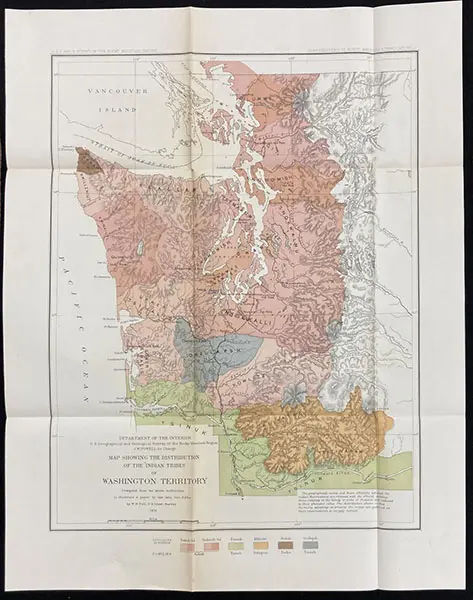
Between 1871 & 1874, Dall conducted several missions to Alaska aimed at surveying the Alaskan Coast, & acquiring specimens. He & his crew collected numerous molluscs, echinoderms, & fossils, which later were shipped to the Harvard Museum of Comparative Zoology to be studied by Louis Agassiz. In addition to this, he also acquired archaeological artifacts (which went to the Smithsonian), & various plants (which went to Asa Gray at Harvard for study) while voyaging.
In August 1878, the 48th meeting of the British Association for the Advancement of Science in Dublin was soon to commence. The United States Coast & Geodetic Survey & Smithsonian decided to send Dall. Dall decided to spend the summer trekking around Europe visiting mollusc collections, & meeting malacologists from various European Universities.
The 35-year-old Dall met & married Annette Whitney in 1880. The pair would have 4 children together, Marcus, William, Charles, & Marion. The newlyweds promptly relocated to Washington D.C. where they would remain for the rest of their lives. They honeymooned across Alaska, finally stopping in Sitka, where Annette went home & Dall began his final survey season aboard the Yukon.
Dall left the United States Coast & Geodetic Survey in 1884, having written over 400 papers with the agency since his book. He transferred to the newly established U.S. Geological Survey, & was awarded the position of paleontologist, focusing on molluscs through the ages. He would remain in this position until 1925, 2 years before his death. As a part of his work, he made numerous trips to study geology as well as fossils throughout the US. These trips primarily focused on the Northeast, though he also made expeditions to Florida & Georgia.
Dall was a member of the notable Harriman Alaska Expedition in 1899. He contributed heavily to several malacological reports which came out of the expedition, including a chapter “Description and Exploration of Alaska”, & Volume 13 “Land and Fresh-water Mollusks”.
Around this time, he also spent 2 months in Hawaii at the Bishop Museum in Honolulu examining their collection of shells.

Unfortunately, Dall passed away on March 27th, 1927, at the age of 81. He is remembered for his numerous scientific contributions, collaborative leadership style, honesty, & work on the American Frontier. His enduring body of scientific work has stood the test of time, & continues to be a valuable asset to scientists today.

His Achievements, Accomplishments, & Awards
1. He published over 1,600 reviews, scientific papers, articles, & commentaries throughout the course of his life.
2. He was an Honorary Curator at the Smithsonian’s Division of Mollusks & Tertiary Fossils from 1868 to his death in 1927.
3. For his illustrious scientific career, he was awarded several honorary degrees. These include an honorary Master’s degree from Wesleyan University in 1888, an honorary doctorate from the University of Pennsylvania in 1904, & an honorary law doctorate from George Washington University in 1916.
4. He personally described approximately 5,427 species, & 354 genera.
5. He was one of the founders of the National Geographic Society.
6. For his scientific contributions, he was awarded the Gold Medal by the Wagner Free Institute of Science in 1888.
Directories / Credits
Citation No. 1: “Dall, William Healey (PhD)”, Written by Unknown, & Published at an Unknown Date. Published by Conchology Inc.
Citation No. 2: “William Healey Dall”, Written by Unknown, & Published at an Unknown Date. Published by PBS.
Citation No. 3: “William Healey Dall: Alaskan Explorer”, Written by Unknown, & Published at an Unknown Date. Published by the Smithsonian Institution Archives.
Citation No. 4: “William Healey Dall”, Written by Unknown, & Published at an Unknown Date. Published by the Linda Hall Science Library Arboretum.
Citation No. 5: “Record Unit 7073
Dall, William Healey, 1845-1927
William Healey Dall Papers, circa 1839-1858, 1862-1927”, Written by Unknown, & Published at an Unknown Date. Published by the Smithsonian Institution Archives.
Citation No. 6: “William Healey Dall”, Written by Unknown, & Published at an Unknown Date. Published by the Notable People Project.
Citation No. 7: “Sense and the science of nineteenth-century environmental determinism”, Written by Brooke Penaloza-Patzak, & Published on May 23rd, 2026. Published by History of Science.
Strategic Partnerships
Reel Guppy Outdoors
SharkedSkooler
Marine Enthusiasts Podcast
Cash Daniels
Tides of Tomorrow
The Open Book, Topanga
Olivenbaum Music
Pitfire Artisan Pizza
Three J’s Kitchen
Presence News
Our Loyal Patrons
P. R. Ochoa


Comments