
Tales From The Baltic: The Largest Human-Induced Oxygen Dead Zone

The area of the central Baltic Sea covering (as of 2024) approximately 70,000 square kilometers is considered the largest human-induced oxygen dead zone. The second largest is located in the Gulf of Mexico, yet it is 3 times smaller than the largest one. However, despite this fact, few people know of its existence, and the importance of preventing it from expanding. Here, we will break down the causes behind the formation of oxygen-depleted areas and go through the consequences that follow.
Hypoxia in relation to marine environments is a term used to refer to depletion of oxygen levels in a water body. The threshold level of hypoxia applies when the dissolved oxygen (DO) drops below 2 mg/L, which prevents marine life from living, in turn causing the formation of ‘dead zones’. In these areas, fish along with benthic organisms (organisms which live on the ocean floor) are unable to live due to insufficient oxygen levels. Mobile organisms such as fish are able to flee to oxygen-rich areas, while sessile organisms such as anemones suffocate.
One of the natural causes for hypoxia to occur is stratification of the water basin. The Baltic Sea is highly stratified with little mixing of the water, limiting the exchange of oxygen from the higher layers to the bottom one. This, combined with the sea being closed-off (which impedes the inflow of oxygen-rich waters from the North Sea) and the large river runoff, this paralyzes the oxygen levels near the sea floor. Only sporadic saltwater inflow that occurs mainly in winter (Major Baltic Inflows MBIs) are able to ventilate the deepest parts of the sea.
Oxygen depletion can also result from eutrophication, which is caused by the excess of nutrients and organic matter increasing productivity and organic matter content that sinks to the sea floor. With time, depleting oxygen levels and decomposition of organic matter shift the processes from aerobic (using oxygen) to anaerobic (without oxygen) which, in turn, leads to less efficient decomposition and increased deposition and accumulation of organic matter on the sea floor. The accumulation of organic matter encourages microbial activity and the consumption of dissolved oxygen in bottom waters.

Due to excessive nutrient inputs since the 1950s, eutrophication in the Baltic Sea has increased. Localized declines of dissolved oxygen levels were noted in the Baltic as early as the 1930s but the hypoxia became widespread 30 years later. Globally, the number of dead zones has doubled each decade since the 1960s. The volume of the area with hypoxia in the central Baltic Sea increased from 15% to 26% since 1960. This trend will be amplified with global warming, increasing the dead zone.
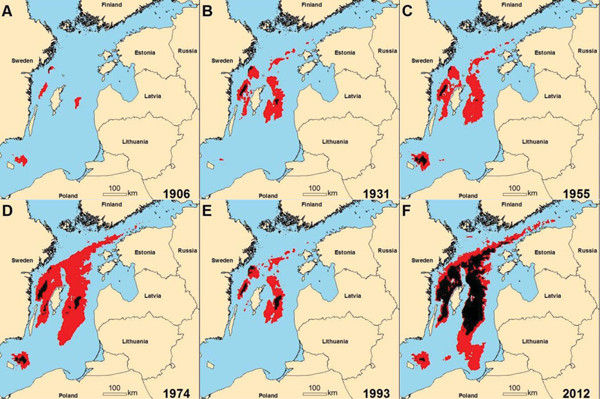
The table below shows the changes in hypoxic (red) and anoxic (black) areas in the deep waters in the Baltic Proper over the years. The graphic clearly shows the expanding problem of oxygen depletion and areas unable to support marine life.
There are different forms of eutrophication-induced hypoxia. The most common one, responsible for half of the known dead zones, occurs once a year. It’s caused by the spring phytoplankton blooms and appears in the summer when the stratification is strongest and the water is warmest, lasting until autumn. Once the oxygen level returns to normal, there is visible recolonization of marine life to some extent. A quarter of hypoxic zones are caused by periodic oxygen depletion happening more often, however it seems to be less severe, usually lasting from days to weeks. This type is represented by waters like the York River in the Chesapeake Bay. Episodic oxygen depletion, happening less than once a year, is the initial sign of reaching a critical point of eutrophication, which then tips the system into hypoxia. Hypoxia increases in time and space, especially in systems prone to stratification, where oxygen depletion may be persistent - this lasting form of oxygen depletion accounts for about 8% of dead zones, including the one in the Baltic Sea.
The progression of hypoxia starts with a pattern seen in eutrophic systems when enhancement of deposition of organic matter promotes microbial growth and respiration, causing a greater demand for oxygen. With the growing oxygen depletion, mass mortalities of benthic animals occur. Then, when hypoxia becomes seasonal or periodic, animal populations cycle between being abundant and nonexistent. With time and persistent oxygen depletion the final phase takes place - the hypoxic zone expands, turning into anoxic waters and in turn generating hydrogen sulfide. Hypoxia alters sedimentary habitats as well, disrupting nitrification and denitrification, causing ammonia, ammonium, and phosphorus to accumulate in the sediments.
It is estimated that in the persistently hypoxic dead zones in the Baltic Sea, there are around 264,000 metric tons of carbon of annually missing biomass, which account for about 30% of total Baltic secondary production. As a result, the secondary production has doubled outside of the dead zones.
Oxygen consumption rates, with one source being the respiration of zooplankton and higher trophic levels, have substantially increased. Paired with organic matter sinking to the sea floor, ineffective ventilation of deep water, slower decomposition under hypoxic and anoxic conditions and remaining oxygen being consumed by the oxidation of hydrogen sulfide, the oxygen concentration is severely low. Nutrient concentrations, like intensified nitrogen fixation, fuel cyanobacteria blooms, which in turn cause even higher oxygen depletion. All those factors outweigh the ventilation and exchange of the deep waters in the sea.
The present conditions in the Baltic Proper make it highly unlikely that dissolved oxygen levels higher than 2 mg/L will retain for extended periods of time. The consequences of those oxygen dead zones follow a pattern revolving around marine mortality and disruption of the food web and ecosystem. This affects aquaculture and fisheries as well, limiting the catch numbers of commercially fished species.
Hypoxia and anoxia are one of the most widespread human-induced environmental issues in marine environments, influencing habitat loss and harmful algal blooms. Managing the nutrient runoff from rivers is crucial in preventing or slowing down the expansion of hypoxic areas. Although the Baltic Sea has the largest oxygen dead zone in the world, there are many ecosystems struggling with similar conditions. It is highly important to note the changes in the ecosystems and prevent these dead zones from forming early on.

Citations / Directories
Citation No. 1: Spreading Dead Zones and Consequences for Marine Ecosystems, Robert J. Diaz, Rutger Rosenberg
Citation No. 2: How oxygen deficiency in the Baltic Sea proper has spread and worsened: The role of ammonium and hydrogen sulphide, Carl Rolff, Jakob Walve, Ulf Larsson, Ragnar Elmgren
Citation No. 3: Recently Accelerated Oxygen Consumption Rates Amplify Deoxygenation in the Baltic Sea, H. E. Markus Meier, Germo Väli, Michael Naumann, Kari Eilola, Claudia Frauen
Citation No. 4: Near seafloor methane flux in the world’s largest human-induced dead zone is regulated by sediment accumulation rate, M. Ketzer, C. Stranne, M. Rahmati-Abkenar, S. Shahabi-Ghahfarokhi, L. Jaeger, M.A.G. Pivel, S. Josefsson, L. Zillén
Strategic Partnerships
Reel Guppy Outdoors
SharkedSkooler
Marine Enthusiasts Podcast
Cash Daniels
Tides of Tomorrow
The Open Book, Topanga
Olivenbaum Music
Pitfire Artisan Pizza
Three J’s Kitchen
Presence News
Our Loyal Patrons
P. R. Ochoa

Comments