
The Documented History Of Iqaluit, Nunavut, Canada

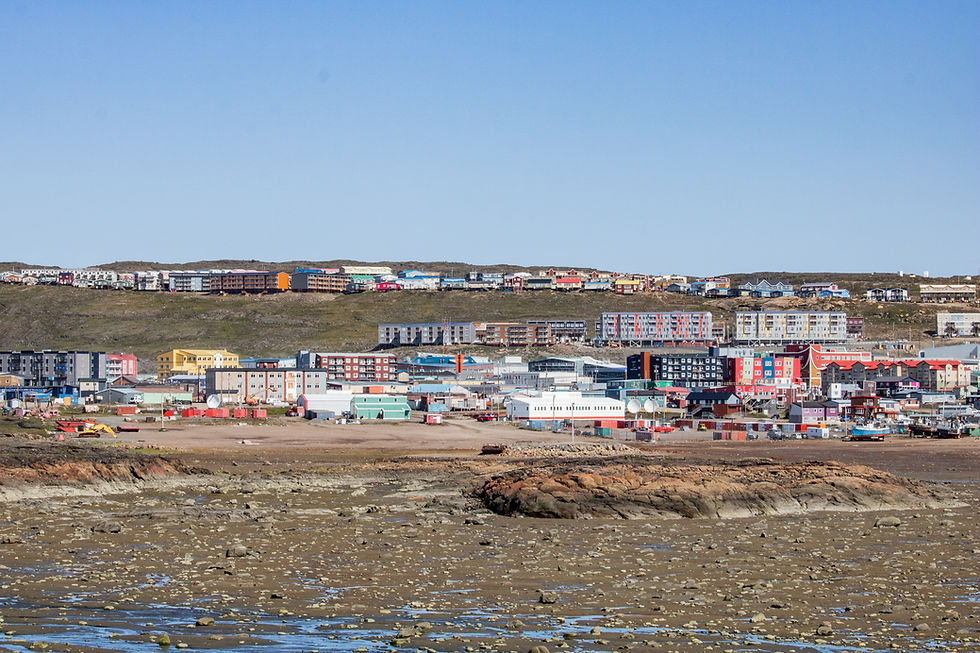
Today’s article shall be discussing the History of Iqaluit, the capital of Nunavut, Canada. Iqaluit is the capital of the Canadian province, Nunavut.
Iqaluit is considered one of the most ideal places for fishing in the nearby area. It is the only city in the entire province, with a minuscule population of 7,429 people. This is the lowest population of any provincial Canadian capital.
Located on the Baffin Island, the city is close to the Arctic circle. Iqaluit was also known by the name “Froshbisher Bay” from 1942 to 1987, at which the cities name was restored to its Inuktitut name. The city encompasses a 19.92 square mile area (51.592563 square kilometers). Outside of Nunavut, the city is not well known for anything.
The city is so small, that there is only 1 paved road in the entire town. The name “Iqaluit” is an Inuktitut name, meaning “Place Of Many Fish”. The reason for this name is that fishing is a long standing tradition of the Inuktitut people of the area. Though Iqaluit is not the most biodiverse land wise, it has some of the most magnificent marine life.
This marine life, such as the beluga whale, is intricately linked to its Inuktitut history, & the Inuktitut people.
The land around Iqaluit has a long &, rich native history. The documented history of Iqaluit begins in 1576, when an english explorer accidentally sailed into Frobisher Bay. Consequently, the city was named Frobisher Bay.
The city is directly on the coastline, & is a mere 30 meters (98.4252 feet) in elevation.
Currently, there is no official language for Iqaluit. Approximately half the population speaks Inuktitut, while 97 percent speak English.
In this article, we will discuss the documented history of Iqaluit, the aboriginals of Iqaluit, & the most destructive natural & man-caused disasters to affect Iqaluit, & finally the economy of Iqaluit. With that being said, let us delve into the history of the Gem of the Arctic!
The Documented History Of Iqaluit
Before Colonization
The Pre-Dorset people migrated from mainland North America to Baffin Island sometime between 1700 B.C & 1,000. The Pre-Dorset people are the original indigenous inhabitants, & are the precursor to all modern Inuktitut & Inuit people & culture.
After Colonization By The British
Historical Events From The 1500’s To The 1700’s
Iqaluit’s history begins in 1576, when British Explorer Sir Martin Frobisher sailed into the bay adjacent to the city. He named it Frobisher Straits, as he believed it was a strait leading to China.
Historical Events From The 1800’s
As whaling became increasingly popular in the early & mid 1800’s, many whalers were attracted to the area. These whalers were some of the first people to develop the city both infra-structurally, & economically. In 1861, Charles Francis Hall arrived at Frosbisher Strait, & investigated whether or not it was the Asian Sea Route it was imagined to be. He quickly learnt from a local hunter, Koojesse, that the Strait, was actually a bay. While on his trip, he camped on the banks of the local river, & inlet. In honour of his geographer, & guide, he named the inlet Koojesse inlet, & the river Sylvia Grinnell River. The land, as well as government, became governed by the government of Canada from 1880 onward.
After Being Transferred To Canada
Historical Events From The 1900’s
During the turn of the century, the whaling market began declining rapidly. Furriers became aware of the economic potential of Iqaluit, & quickly began moving to the city. Additionally, the Catholic & Anglican Church began building missionaries in & around the city.
In 1914, The Hudson Bay Company opened a trading post in the Ward Inlet, located approximately 40 miles away from modern Iqaluit. The company would go on to establish more trading posts around Baffin Islands in the 1920s. As fur prices began to crash in the early 1930s, many furriers withdrew their stakes around the city. In the wake of this, the local Inuktitut economy also crashed, as many of their animals were over-hunted. This left them with few source of income or food.
As the U.S was building more bases in the Arctic Areas, Koojesse inlet was chosen as the site of a massive Air Force base. This air force base is known as the Frobisher Bay Air Base. In 1943, The nearby trading post was moved to Apex, in order to support the Inuit who has moved further up the bay. As the city began growing, the cold war began becoming a larger issue for the U. S. For this reason, the U.S decided to build a radar DEW station near the city. This new project brought many new workers, as well as supplies to the area.
In 1957, the population was estimated at 1,200, 489 of which were Inuktitut. As the Canadian government began recognizing the city was a city, doctors, teachers, administrators, clerks, & law enforcement was brought to the area. Many Inuktitut communities relocated to the city around this time, as many of them saw a city of destiny.
In 1963, Iqaluit became the official Canadian administrative, transportation, & communications capital of the eastern Arctic wintry North. The first community council was formed a year after, as some form of local government had to be established. Soon after, in 1970, Iqaluit was officially recognized as a settlement. 4 year later, in 1974, the area was officially recognized as a village.
In 1979, the first Mayor of Iqaluit is elected, that being Bryan Pearson. A year thereafter, the Canadian government recognized the village as a town. As mentioned in the introductory paragraph, in prior to 1987 the city was named Frobisher Bay. Only in 1987 was the cities name officially restored to its Inuktitut name, which is Iqaluit.
The Indigenous Aboriginals Of Iqaluit
The Inuit Indigenous Aboriginals
The Inuit Indigenous Aboriginals an indigenous peoples group native to the Arctic. Their native language is the Inuktitut language. Local groups have adapted different dialects over the centuries, however they all have the same Inuktitut base.
The Inuit peoples have generally been peaceful, & rarely have initiated violent conflict without reason, with the exception of the group living in the Mackenzie River Delta. Hunting is the true one of the fundamentals of Inuit culture, with extensive knowledge & training being passed down through generations. Their traditional Inuit diet includes many animals, that are often consumed raw. The most common of these animals is the ringed seal, as it inhabits Nunavut year round, thus ensuring a healthy food source throughout the year. In Inuit culture, it is popular to consume 2 large meals throughout the day, & then 1-7 small snacks each hour between meals. Traditional Inuit hunting tools range from spears, to hand held harpoons.
As for plants, it is extremely difficult to cultivate anything in the thick winter climate of Iqaluit. In the summer, crowberries, & seaweed are fairly popular. Clothing is designed with warmth in mind, & garments were often designed for a specific individual. These garments were made to last an extremely long time, as it is takes weeks to craft just 1 parka. The traditional garments consist of a parka, pants & mittens made with caribou fur, a sealskin under layer, & 2-4 layers of footwear depending on the season. These garments occasionally had engravings, that often had a religious undertone.
Inuit individuals generally are shorter in stature, with tanned skin, & have an elongated nose, which allows them to warm up air quickly, which is useful for such a frigid environment.
Jewelry has historically been small, & made with beads. These beads ranged being made of shell, to being made of gemstones. Amulets are commonly worn while hunting, as they symbolize good luck & protection.
Their familial construct is built around the extended family, with children living at home until, & occasionally after being married. Inuit relationships are much more open, & less strict then other cultures.
Traditional Inuit music is often made to tell a story, & is often played using drums. Festivals are often held, with drum dancing, singing, & a lot of storytelling.
As for games, harpoon throwing, knuckle hopping, airplane planking, & endurance games are popular.
Shamans & priests were, & still are popular for spiritual guidance. As for Inuit religious practices, the traditional belief is that the entire world is governed by spirits, & that practically everything has, or is governed by a spirit. This religious principle is known as Animism.
The Most Destructive Natural & Man-Caused Disasters To Affect Iqaluit
Unfortunately, there seems to be very little information on disasters to have affected Iqaluit. We have yet to find any disasters that have caused significant casualties, damage, or injury to substantial amount of individuals.
The Economy Of Iqaluit
Overall, the Economy of Iqaluit is rather stable. The main industries of Iqaluit are currently, commercial fishing, oil, & mining. Transportation is also quite a large industry, as Iqaluit is the transportation capital of Nunavut. There are very few roads outside of Iqaluit, & there are no highways connecting the islands of Nunavut. For this reason, flying from one island to another is the most common method of transport. Iqaluit is slightly suffering though, as their economy is hard to sustain with such a minuscule population. The average full time salaried employee in Iqaluit makes approximately 87,500 U.S.D (118,557.69 Canadian Dollars), & the average household income is approximately 177,800 U.S.D. (240,909.22 Canadian Dollars).
With all current exchange rates, the average cost of living is approximately 7,952 U.S.D (10,774.52 Canadian Dollars) per month.

Directories / Credits
Citation No. 1: “About Iqaluit: History & Milestones”, Written by Unknown, & Published at an Unknown Date. Published by the Government Of Iqaluit. Retrieval Date: March 1st, 2024.
Citation No. 2: “The Founding Of Iqaluit - Arctic Kingdom”, Written by Admin, & Published on October 4th, 2019. Published by Arctic Kingdom. Retrieval Date: March 1st, 2024.
Citation No. 3: “Inuit”, Written by Minnie Aodla Freeman, Published on June 8th, 2010. Published by The Canadian Encyclopedia. Retrieval Date: March 1st, 2024.
Citation No. 4: “Inuit”, Written by the Inuit Circumpolar Council, & Published on July 20th, 1998. Published By The Encyclopedia Britannica. Retrieval Date: March 1st, 2024.
Citation No. 5: “Inuit Nunangat”, Written By Unknown, & Published at an Unknown Date. Published By the Canadian Geographic Indigenous Peoples Atlas Of Canada. Retrieval Date: March 1st, 2024.
Citation No. 6: “What Is A Good Salary In Iqaluit, Nunavut?”, Written by Unknown, & Published at an Unknown Date. Published by CareerBeacon. Retrieval Date: March 1st, 2024.
Citation No. 7: “Inuit Games”, Written By Unknown & Published at an Unknown Date. Published By The Canadian Geographic Indigenous Peoples Atlas Of Canada. Retrieval Date: March 1st, 2024.
Strategic Partnerships
Reel Guppy Outdoors
SharkedSkooler
Marine Enthusiasts Podcast
Cash Daniels
Tides of Tomorrow
The Open Book, Topanga
Pitfire Artisan Pizza
Olivenbaum Music
Our Loyal Patrons
P. R. Ochoa


Comments