
The Oceans Surrounding Iqaluit, Nunavut, Canada

Updated: Dec 23, 2025

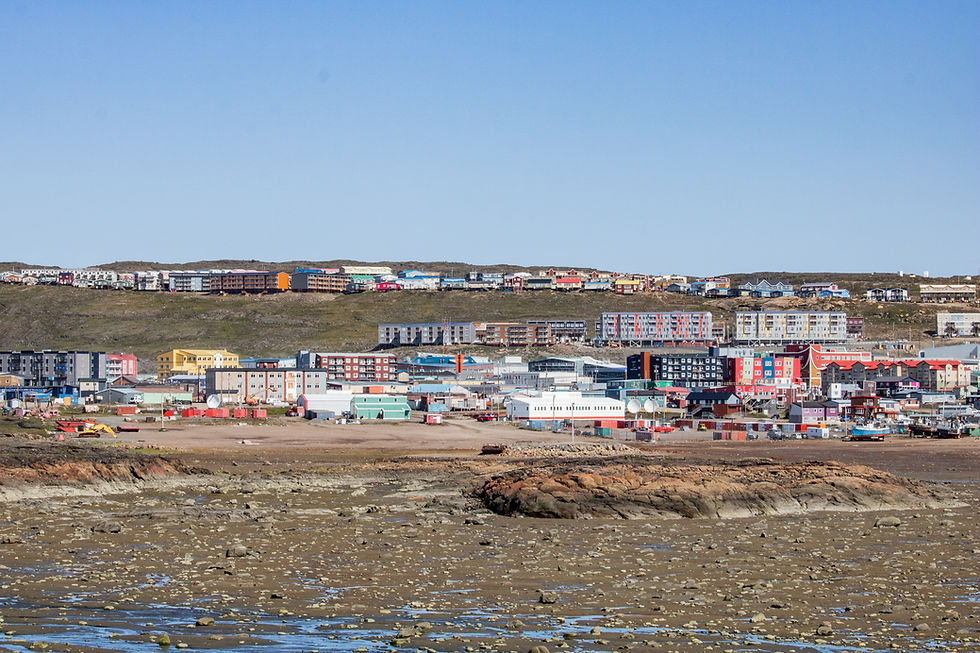
Today’s article shall be discussing the oceans surrounding Iqaluit, the capital of Nunavut, Canada. Iqaluit is the capital of the Canadian province, Nunavut.
Iqaluit is considered one of the most ideal places for fishing in the area. It is the only city in the entire province, with a minuscule population of 7,429 people. This is the lowest population of any provincial Canadian capital.
Located on the Baffin Island, the city is close to the Arctic circle. Iqaluit was also known by the name “Frobisher Bay” from 1942 to 1987, at which the cities name was restored to its Inuktitut name. The city encompasses a 19.92 square mile area (51.592563 square kilometers). Outside of Nunavut, the city is not well known.
The city is so small, that there is only 1 paved road in the entire town. The name “Iqaluit” is an Inuktitut name, meaning “Place Of Many Fish”. The reason for this name is that fishing is a long standing tradition of the Inuktitut people of the area. Though Iqaluit is not the most biodiverse land wise, it has some of the most magnificent marine life. One of the creatures that makes up their marine ecosystems, it the Beluga Whale.
We covered this species in an article published 10 days prior to this one, which readers may view if they are interested. The majority of the marine species around the city, are marine mammals.
Currently, Marine Species Management Services estimate that there are approximately 21 species of pinniped found around the Iqaluit, & the surrounding islands.
In this article we will discuss the salinity, tides, temperatures, marine geography, & depth of the oceans surrounding Iqaluit, the most prominent marine ecosystems of the oceans surrounding Iqaluit, the documented marine flora & fauna of Iqaluit, & how ocean acidification & rising oceanic temperatures are affecting the oceans surrounding Iqaluit. With that being said, let us delve into the jewel of Nunavut!
The Salinity, Tides, Temperatures, Marine Geography, & Depth Of The Oceans Surrounding Iqaluit
The salinity of Iqaluit is currently unmeasured. Since Iqaluit is surrounded by the Arctic Ocean, the salinity of Iqaluit most likely rests between 30 & 34 Parts Per Thousand. Salinity is currently measured in 1000 gram increments of water. For example, 30 grams of salt per every 1000 grams of water would be expressed as 30 parts per thousand. Additionally, though parts per thousand is considered the proper name for the measurement, some sources will instead refer to it as practical salinity units.
The tidal charts for Iqaluit can be found on a variety of websites, including: https://www.tideschart.com, https://www.tide-forecast.com, https://tides.today, & https://www.tidetablechart.com. The tides tend to not reach higher then 10.7 meters (35.10499 feet) tall, & no lower then 0.5 (1.64042 feet) meters.
The oceanic temperature charts can be found on similar websites, a few of which are: https://seatemperature.info, https://seatemperatures.net, https://www.watertemp.org, & https://www.watertemperature.org.
The average yearly oceanic temperature is approximately 31.02499999999995239° Fahrenheit (-0.54166666666667 Celsius).
Using a wetsuit guide, at this temperature it is recommended that you wear a drysuit. Iqaluit is not known to have any common riptides. Though the ocean around the city is safe for swimming, it never gets warm enough to swim without a drysuit. Pollutants are not found in the water, & the ocean water is rather clean & clear. There are very few oceanic activities to do around the area.
Very few diving expeditions are launched here unless it is for a scientific purpose. The few that are, are highly structured & are usually hosted by travel agencies. There is very little tourism in the city, as the city is not very well known. Iqaluit has very few sea mounts around it, as the geography does not permit them. The oceanic floor around the city largely consists of rock.
With all current research, the deepest oceanic point within a 5 nautical mile (5.7539 miles or 9.26 kilometers) radius of Iqaluit is 419.9 feet (127.98552 meters) deep.
The Most Prominent Marine Ecosystems Of The Oceans Surrounding Iqaluit
Ecosystem Type No. 1: Intertidal Zones
Intertidal zones are located along the coastlines, & are areas which are exposed to air at low tide, as well as submerged at high tide. These zones are wear the ocean meets the shoreline, & contrary to popular perception, are absolutely teeming with oceanic life. From crabs to bivalves, this ecosystem has a unique variety of marine life, as well as a unique variety of features. These zones generally have species from the phyla Echinodermata, Arthropoda, & Mollusca in them. Additionally, these zones may have tide pools.
The Documented Marine Flora Of Iqaluit
Unfortunately, we cannot provide information on the marine flora of Iqaluit, as there is little to no data on them.
The Documented Marine Fauna Of Iqaluit
Though Iqaluit isn’t the most biodiverse, the city has a flourishing population of marine life. Unfortunately, due to the inhospitable environment, there is very little data on exactly which species inhabit the cities shoreline.
Many marine species will migrate to Iqaluit as a part of their natural migrational process, & as a result, it is hard to track them. There are very few species that are found year round, with the most prominent one being the Ringed Seal.
As of 2025, there are no known endemic marine fauna species that are endemic to Iqaluit. For the purposes of this article, we will not be including planktons, parasites, marine insects, or waterfowl.
With that being said, below is a list of all the most prominent marine species known to be found around the city: Monoceros monodon (Narwhal), Delphinapterus leucas (Beluga Whale), Balaena mysticetus (Bowhead Whale), Pusa hispada (Ringed Seal), Odobenus rosmarus (Walrus), Salvelinus alpinus (Arctic Char).
How Ocean Acidification & Rising Oceanic Temperatures Are Affecting The Oceans Surrounding Iqaluit
Ocean acidification is caused by increased levels of carbon dioxide in the atmosphere. Atmospheric carbon dioxide levels have increased, largely because of human-caused burning of fossil fuels, & deforestation, for the past 150 years. When carbon dioxide contacts sea water, it forms carbonic acid. Carbonic acid gives off positive H+ ions, which causes increased oceanic H+ concentrations & decreased oceanic Ph. When the ocean has decreased Ph, it effectively acidifies.
When this happens, it causes conditions that will eat at the shells of bivalves, stress out & eventually bleach coral, & utterly destroy seagrass patches.
The effects of this are being seen the most dramatically in Arctic & Antarctic areas, which Iqaluit is located in. Ocean Acidification currently poses a massive threat to the hard shelled organisms of Iqaluit, & if not taken action upon, will eventually lead to ecological destabilization.
As for rising oceanic temperatures, its affects are being seen now in Iqaluit. This form of climate change is affecting the migrational patterns of fish, which is & will affect the Inuktitut Communities. Many of these small communities rely on fishing & hunting to sustain themselves, & their local economy. If the fish, or seals become locally extinct, then it will have devastating economic, food security, & ecological implications for the Inuktitut Indigenous Aboriginals. For more information as well as ways to avoid this uninviting future, please visit https:// www.climatechangenunavut.ca.

Directories / Credits
Citation No. 1: “Wetsuit thickness & temperature guide”, Written By Mark Evans, & Published On April 24th, 2023, at 3:05 PM. Published By Scuba Divers Magazine. Retrieval Date: February 26th, 2024.
Citation No. 2: “Wildlife Viewing Animals”, Written by Unknown, & Published at an Unknown Date. Published By Travel Nunavut. Retrieval Date: February 26th, 2024.
Citation No. 3: “Species In Nunavut”, Written By Unknown, & Published At an Unknown Date. Published by Travel Nunavut. Retrieval Date: February 26th, 2024.
Strategic Partnerships
Reel Guppy Outdoors
SharkedSkooler
Marine Enthusiasts Podcast
Cash Daniels
Tides of Tomorrow
The Open Book, Topanga
Pitfire Artisan Pizza
Olivenbaum Music
Our Loyal Patrons
P. R. Ochoa


Comments