
The Documented History Of Saint-Jean-de-Luz, France


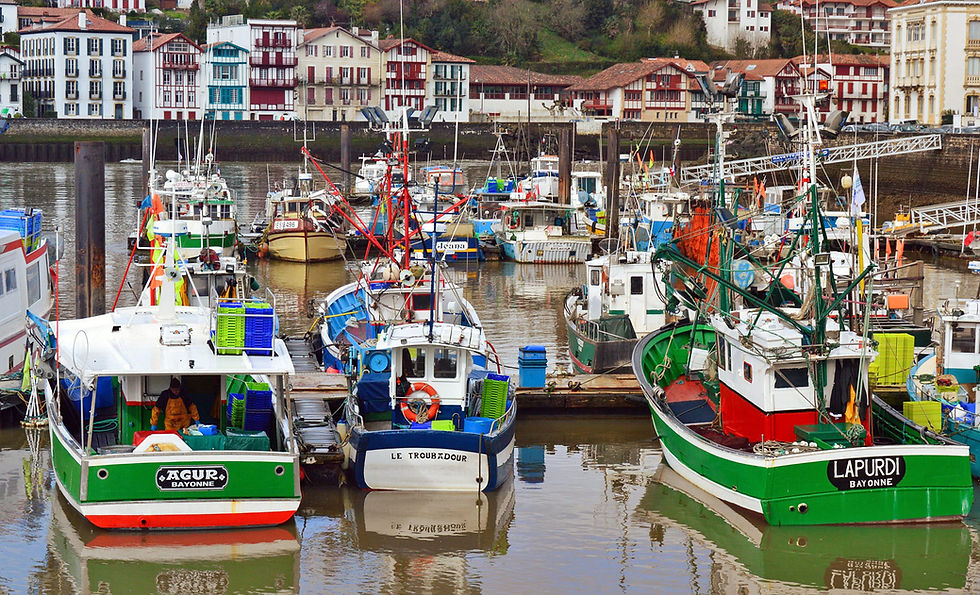
Saint Jean De Luz is a small fishing town in the center of the Bay of Biscay, along the Western Coastline of France. Its name is derived from Saint Jean, & the fact that the city was flooded often over its centuries of existence. Saint Jean De Luz means “Saint Jean’s Swamp”, as the town occasionally is flooded to the point of being partially underwater. It is near the border between France & Spain, in the Basque Region.
The city itself is approximately 7 square miles, with a population density of roughly 2,000 people per square mile. The city is well known for its fisheries, wildlife, beaches, casino, spas, & luxurious resorts. Both international & domestic tourists flock to the area seeking relaxation, & a tranquil atmosphere. Many festivals & events are held in the town, as it is an accessible location to both the French, & the Spanish. The coastline around the city is the site of many fisheries, & marine animals.
The city itself has a very long & rich history as a meeting place for both the Spanish & the French. It is the birthplace of the Treaty of the Pyrenees, which ended the Franco-Spanish War of 1635.
Additionally, it is the wedding place of Maria Theresa, Infanta of Spain, & Louis XIV of France, the longest reigning monarch of any nation. This marriage was one of the most important political marriages in both Spanish & French History, as it brought about the end to an extremely bitter war. Overall, the city has been especially appreciated by Spanish & French Aristocracy, & nobles.
In this article, we shall discuss the Documented History of Saint-Jean-De-Luz, The Indigenous Peoples Of Saint-Jean-De-Luz, & The Economic State of Saint-Jean-De-Luz. With that being said, let us delve into magnificent history of Saint-Jean-De-Luz.
The Documented History Of Saint-Jean-De-Luz
Historical Events From The 1600’s
Saint-Jean-De-Luz had existed since at least the 1400’s, however it was not given much attention until the 1600’s. Beginning in 1659, Catholic Cardinal Jules Mazarin spent several months in the town, to host meetings between the French & the Spanish, to organize the Treaty of the Pyrenees. Soon after In 1660, Louis the XIV of France & Maria Theresa, The Infanta Of Spain, choose a cathedral in the town as their wedding venue. This marriage is what officially brought with it the end of the Franco-Spanish War, as the Treaty of Pyrenees was technically a clause in their marriage contract. They hosted the wedding on June 9th, 1660, in the local Cathedral. Immediately after, they had the front entrance of the cathedral walled off. There are varying theories as to why the couple choose this, however the most popular are that they wished for it to represent the conflict between their respective nations coming to an end, or that they wished to be the only couple to ever wed in the church.
Historical Events From The 1700’s & 1800’s
During the Peninsular war between Denmark-Norway, Britain, France, Spain, Portugal, & Italy, the Duke of Wellington set up his winter military base in the city. The base was in operation from 1813 to 1814.
Historical Events From The 1900’s
The city played a minor role in World War 2, as in 1940, 55,000 Retreating Polish Soldiers were evacuated from the area. These soldiers were attempting to get to ships leaving further north, however they couldn’t reach them in time. Approximately 5 different passenger ships from Britain & America quickly sailed to the harbour, to retrieve these men. In total, 24,352 men were successfully evacuated.
After the war ended, the fishing industry began to decline, & the tourism industry began to increase rapidly. As the 1960’s approached, More buildings were built along the harbour front, & the city was expanded. Modernly, the city is a place of much tourism, luxury, & is one of the cultural centers of the Basque Region.
The Indigenous Peoples Of Saint-Jean-De-Luz
The Basque People
The Basque’s are a group of Indigenous peoples from the Iberian Peninsula, & South Western Europe. They inhabit an area known as the Basque Country, which encompasses Northern Spain, Southern France, & part of the Pyrenees. This area is also known as Euskal Herria. They speak the Basque Language, a language isolate. They have generally been a peaceful civilization, & are known for their astounding hospitality. Potatoes, tolosa beans, wheat, barley, olives, grapes, chestnuts, & lentils have been some of the staple crops for the Basque People throughout the centuries. Their meats largely consist of lamb, along with beef, & fish takes up a considerable portion of their diet.
Fishing is an extremely important part of Basque Culture, & has been generating profits for the Basque People since the 1600’s.
Their traditional clothing is very long & modest to combat the cold climate. For women & girls, it consists of long skirts with a scarf to cover the head, that is tightly fitted at the waist & occasionally embroidered.
For men, it consists of a loose shirt, long pants, & a traditional hat known as a txapela. Scarves are very popular for both the head & the neck as well, to defend against the frigid weather in the winter.
Individuals from this group have been described to have pale skin, dark brown hair, flat noses with small bumps, & brown eyes. The social structure of the ideal Basque life is based around the cuadrilla, which is a close group of friends. The cuadrilla has protective rights & duties to each other, & to support each person in the group. Each family is based on a 2 parent household, with 2 loving spouses. Males & females are equal, & both male & female heirs are regarded in the same way. The majority of the people are Christians, of either the Catholic Church or one of the Protestant Churches.
The Economy Of Saint-Jean-De-Luz
The economy of Saint-Jean-De-Luz is heavily dependent on tourism, & fishing. Approximately 10,000 fish from varying species are harvested off the coast of Saint Jean De Luz each year, which is then shipped around France or sold at the local seafood markets. The most popular species of fish caught near the city are sardines, as sardines are abundant in the area. The area is heavily dependent on tourism, both international & domestic. Approximately 40% of the homes in Saint Jean De Luz are secondary homes, as the area is a popular place for Europeans to retire. The city is considered to be a resort town, with many luxurious hotels & rental homes.
Directories / Credits
Citation No. 1: “The City Of Saint-Jean-De-Luz”, Written by Unknown, & Published at an Unknown Date. Published by Madison. Retrieval Date: May 31st, 2024.
Citation No. 2: “The Golden Age Of Saint-Jean-De-Luz”, Written by Unknown, & Published at an Unknown Date. Published. By La Demeure Historique. Retrieval Date: May 31st, 2024.
Citation No. 3: “Overview of Saint Jean go de Luz”, Written by Unknown, & Published at an Unknown Date. Published by the Eusko Guide. Retrieval Date: May 31st, 2024.
Citation No. 4: “The Basque Country, Who was the Basques”, Written by Daniella Levy, & Published at an Unkown Date. Published by MyHeritage. Retrieval Date: May 31st, 2024.
Citation No. 5: “Saint-Jean-de-Luz : The Royal City”, Written by Unknown, & Published at an Unknown Date. Published by the Office Of Tourism for the Basque Country. Retrieval Date: May 31st, 2024.
Strategic Partnerships
Reel Guppy Outdoors
SharkedSkooler
Marine Enthusiasts Podcast
Cash Daniels
Tides of Tomorrow
Olivenbaum Music
The Open Book, Topanga
Pitfire Artisan Pizza
Three J’s Kitchen
Our Loyal Patrons
P. R. Ochoa


Comments