
The Giant Oceanic Manta Ray of Phang Nga Bay, Thailand (Mobula birostris)


This month’s article series will be discussing the gorgeous region of Phang Nga Bay. Phang Nga bay is a bay on the southern coast of Thailand, between the mainland & Phuket island. It is well known for its small islands dotted around the bay, limestone formations, underwater caves, & mangrove forests.
Many divers flock to the area each year, to photograph the marine animals, swim the bay, & take in the surreal beauty around them. There are many areas for swimming, kayaking, snorkelling, & picnicking on the islands in the bay, & on the mainland coastline that borders the bay. It is common for tourists to travel between Phuket, & the Phang Nga, as the drive is approximately 1 hour & 54 minutes under optimal circumstances.
Many tourists travelling the coast of Thailand will pass through the area for a day trip, to enjoy the beauty of the area. The entire bay is protected as a marine protected area as a part of Ao Phang Nga National Park. In addition to its beautiful landscape, the island is extremely biodiverse.
The bay is filled with many beautiful ecosystems, ranging from mangrove forests to coral reefs. One of the popular creatures of the area, is known as the giant oceanic manta ray.
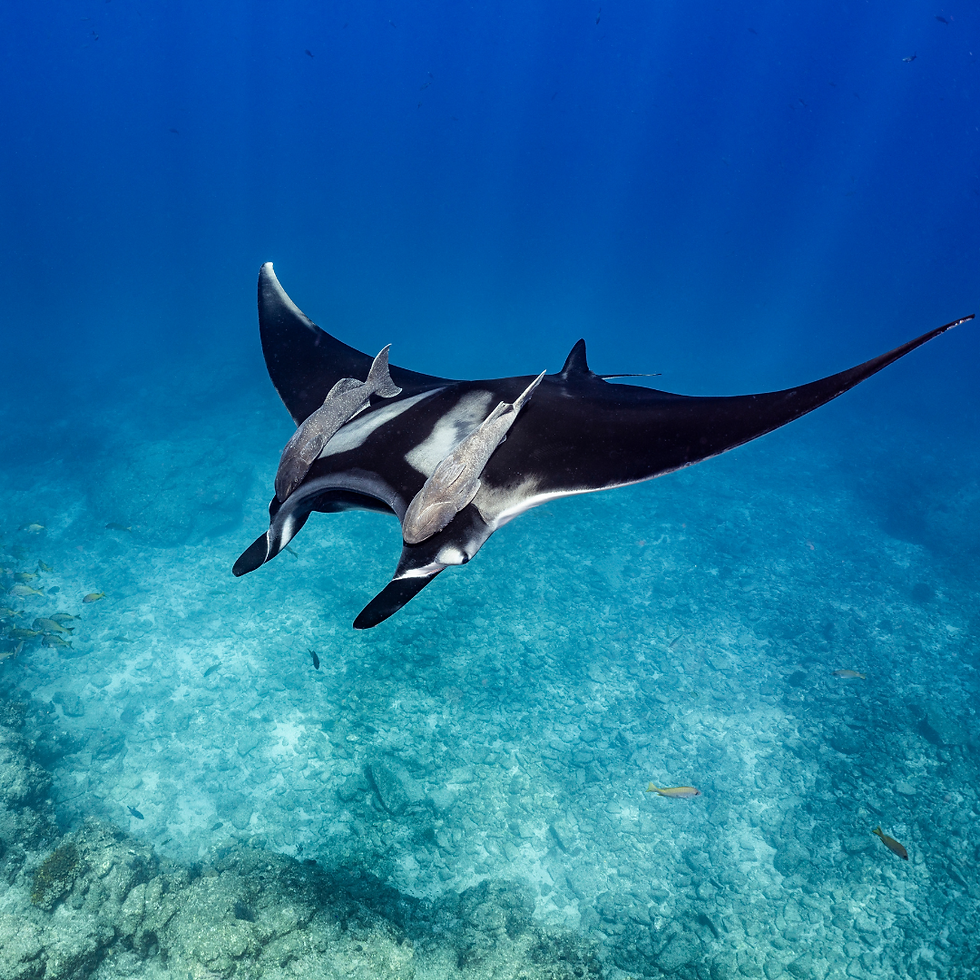
The giant oceanic manta ray is the largest species of ray in the world, with the second largest being the Reef Manta Ray. This species is extremely large as its name implies, getting to the astonishing 30 feet long. Though they are large, they are not very temperamental animals, & are gentle giants of the ocean. They are passive animals, & don’t bother divers unless they are provoked. They have very long tails, & do not have poisonous barbs on them. Manta rays are not venomous, & cannot sting divers.
The giant oceanic manta rays are a decent source of eco-tourism for the region, as many people wish to swim with them in a natural setting.
In this article, we will be discussing the discovery & life of the giant oceanic manta ray, the mating tactics, techniques, habits, procedures, practices, & strategies of the giant oceanic manta ray, the distribution of the giant oceanic manta ray, & the scientific detailings of the giant oceanic manta ray. With that being said, let us delve into this gentle & fascinating behemoth of the ocean.

The Discovery & Life Of The Giant Oceanic Manta Ray
Giant Oceanic Manta Ray’s were discovered in 1798, by German Naturalist & Taxonomist, Johann Julius Walbaum. As mentioned in the Introductory paragraph, Giant Ocean Manta Ray’s are able to reach up to 30 feet (9.144 meters). in length. Their maximum weight is approximately 3,600 pounds (1632.933 kilograms). Unfortunately not much is known about their longevity, however they are believed to live up to 45 years old.
Manta Ray’s are far more intelligent then most fish species. An example of this is that they are able to create mental maps of their environments using visual cues, & use them to navigate. Additionally, they have some level of self awareness, as when put in front of a mirror, they don’t attack it, or respond to it as if it is another individual. Of all fish, their brains are some of the largest both physically, & relative to their bodies. Their brain’s are very developed as well, with the parts of their brain responsible for learning being especially developed.
Giant oceanic manta rays have mild temperaments, & are generally extremely relaxed. They can be rather playful on occasion, & are generally curious creatures. They only become aggressive if provoked, & rarely cause serious issues for humans.
Individuals are often territorial, & stay in the same area throughout their life. It is not clear whether or not they will attack other rays in defence of their territory. Individuals are known to congregate when feeding.
Manta rays will have a cruising speed of 14.5 miles per hour (23.33549 kilometers per hour), however if faced with a threat, they can swim as fast as 22 miles per hour (23.33549 kilometers per hour). They swim by oscillating their fins up & down, which propels them forward. Depending on fast they wish to swim, they will oscillate their fins faster, or slower. This type of swimming is called undulatory swimming. They are incredibly graceful as well as agile with their swimming, being able to navigate the water column with ease. Similar to sharks, manta rays remain buoyant by storing extra oil in their livers, that weighs less than the water around them.
It is currently unknown to science how manta rays sleep. They seem to be in constant motion, gliding through the ocean with a sophisticated ease. This is because in order to absorb oxygen from the water, water has to always be going over their gills. If they stop moving, they begin to suffocate, & eventually pass away.
Giant oceanic manta rays are filter feeders, meaning that they feed on microorganisms such as plankton, copepods, decapod larvae, cephalopod larvae, fish larvae, shrimp, & occasionally small fish. They are not cannibalistic at any stage in their lives. They feed by opening their large mouth, & having organisms simply fall into their mouth. Although they are cathemeral, they will consume the most at nighttime. With such a large body weight, they must consume between 55 & 75 pounds of food per day to survive. Due to their massive size, very little is able to predate upon them.
The few predators that are able to fight them fairly, are orcas, humans, & large sharks. Giant oceanic manta rays have large diamond shaped bodies with elongated wings, small eyes, wide mouths, ventrally placed gill slits, & are usually black or grey with a white belly.
Unfortunately, they are classified as endangered by the IUCN Red List. They were last accessed on November 12th, 2019, & have a population trend listed as decreasing.
The Mating Tactics, Techniques, Habits, Procedures, Practices, & Strategies Of The Giant Oceanic Manta Ray
Giant oceanic manta rays breed via sexual reproduction, & have 2 distinct sexes. They are not naturally hermaphroditic. Their breeding system is polygamous.
Of all the Elasmobranchs, they reproduce the slowest. Both male & female individuals will sexually mature at 8 to 9 years of age. There is a specific breeding season for Manta Ray’s, that being Late December to Mid-April. During breeding season, they will congregate
in large gathering’s known as mating balls.
Once a female has found a male, they will breed via internal fertilization, in which they will have a sexual union. After this the male will not have any role in the children’s, or the females life.
Giant oceanic manta rays are ovoviviparous, meaning that they gestate children in eggs, however they gestate the children inside of the mother. The mother ray will gestate her child for 1 year, & give birth to a single pup. It is rare to have twins, as the children must be a certain size at birth to ensure survival, & there too little room in the mothers womb to comfortably allow for that.
After giving birth, the mother will provide no further care to the baby, & the little ray will swim off into the ocean, ready to take on the world. She will wait at 1 to 4 years until she has another child.
The Distribution Of The Giant Oceanic Manta Ray
This species is found all around the world in both temperate & tropical regions between the 35° Parallel North & the 35° Parallel South. They currently inhabit the Indian, Atlantic, & Pacific Ocean. They are not migratory animals, & will stay in the same areas throughout their entire lives.
Giant Oceanic Manta Ray’s inhabit areas as shallow as 10 feet (3.048 meters) & as deep as 3,280.84 feet (1,000.000032 meters).
The Scientific Detailings Of The Giant Oceanic Manta Ray
Giant Oceanic Manta Ray’s arose during the early Miocene, approximately 23 million years ago. Due to the fact that they have a cartilaginous skeleton instead of a calcified skeleton, it is very difficult for them to fossilize.
There are only 3 sediment beds in the world with giant oceanic manta ray fossils, 1 of which is in South Carolina, & 2 of which are in North Carolina.
Manta rays, similar to sharks, are known to have remoras attach to their backs. The 2 most common remora species that attach to the manta ray are Remora remora (Common remora), & Echeneis naucrates (Slender sharksucker). Remoras are not the only species that enjoy hitchhiking with manta rays, as 11 other species of fish have been identified to swim along side the Manta Ray for long distances.
Contrary to popular belief, giant oceanic manta rays do not have venomous stingers, & cannot hurt humans in that way.
Individuals have very small reduced teeth, that are minimal in the digestive process. The only purpose of these teeth is to direct plankton & water into their mouth.
Their phylum is Chordata, meaning that they developed these 5 characteristics all species under the phylum of chordata develop 5 similar characteristics either In adulthood or as juveniles. The characteristics that they develop include, a notochord, dorsal hollow nerve cord, endostyle or thyroid, pharyngeal Slits, & a post-anal tail.
Their class is Chondrichthyes. This is a class of fish that are primarily composed of cartilage. This class can be compared to the class Osteichthyes, which is a class of fish who are primarily composed of bone. A few universal characteristics for any fish in the class Chondrichthyes is that they all are jawed vertebrates, they have paired fins, paired nares, scales, & a heart with chambers in a series.
Their order is Myliobatiformes, which is an order of Batiods. This order comprises of all living rays.
Their family is Mobulidae, an order of pelagic rays. The majority of species in this family spend the majority of their time in open ocean, instead of on the ocean floor.
Their genus is Mobula, a new genus of ray. This genus contains the 2 largest species of Manta Ray on Earth. Their binomial name is Mobula birostris.
Directories / Credits
Citation No. 1: “Giant Manta Ray”, Written by Unknown, & Published at an Unknown Date. Published by Oceana. Retrieval Date: April 26th, 2024.
Citation No. 2: “Manta ray brainpower blow other fish out of the water”, Written by Amy Mcdermott, & Published on July 25th, 2017. Published by Oceana. Retrieval Date: April 26th, 2024.
Citation No. 3: “Giant Manta Ray” Written by Unknown, & Published at an Unknown Date. Published by the Save our Seas Foundation. Retrieval Date: April 26th, 2024.
Citation No. 4: “All About The Mysterious Giant Manta Ray”, Written by Unknown, & Published on December 28th, 2020. Published by Manta Ray Advocates. Retrieval Date: April 26th, 2024.
Citation No. 5: “Oceanic Manta Ray”, Written by Unknown, & Last Updated in 2022. Published by the International Union For The Conservation Of Nature. Retrieval Date: April 26th, 2024.
Citation No. 6: “Manta Ray Behaviour”, Written by Hannah Brown, & Published on April 12th, 2023. Published by Sea Paradise. Retrieval Date: April 26th, 2024.
Citation No. 7: “Manta Birostris”, Written by Nancy Passarelli & Andrew Piercy, & Published at an Unknown Date. Published by the Florida Museum. Retrieval Date: April 26th, 2024.
Citation No. 8: “Oceanic Manta Ray”, Written by Unknown, & Published at an Unknown Date. Published by the Manta Trust. Retrieval Date: April 26th, 2024.
Citation No. 9: “For manta rays, parasitic hitchhikers can be a pain in the rear, study finds”, Written by Elizabeth Claire Alberts, & Published in July, 2021. Published by Monga Bay. Retrieval Date: April 26th, 2024.
Citation No. 10: “Giant Manta Ray”, Written by Unknown, & Published at an Unknown Date. Published by the National Atmospheric & Oceanic Administration. Retrieval Date: April 26th, 2024.
Citation No. 11: “Giant Manta Ray”, Written by Unknown, & Published at an Unknown Date. Published by Save Our Seas. Retrieval Date: April 26th, 2024.
Strategic Partnerships
Reel Guppy Outdoors
SharkedSkooler
Marine Enthusiasts Podcast
Cash Daniels
Tides of Tomorrow
The Open Book, Topanga
Olivenbaum Music
Pitfire Artisan Pizza
Our Loyal Patrons
P. R. Ochoa


Comments