
The Pacific Tide: What Is A Harmful Algal Bloom?


California’s Pacific coast is one of the most biodiverse and abundant ecosystems worldwide teaming with almost 2000 species of microorganisms, plants, fish, marine mammals, turtles, invertebrates and sea birds supported by a Mediterranean climate. Its famous off-shore, underwater and coastal rock formations date back to the Crustaceous period and help subsidize this special bionetwork making the state’s ocean waters and sea life sacred and unique. Unfortunately, California’s precious coastal ecosystem also faces massive threats in the vein of climate change/global warming, the devastation of kelp forests, ocean acidification, algal blooms and habitat destruction; sounding the alarm for the time-sensitive need for human intervention, conservation management and awareness.
The Pacific Tide series highlights monthly oceanic events occurring on the California coast and/or portrait important species who call the Pacific coastline waters home emphasizing the importance of conserving this critical ecosystem.
In this month’s installment of The Pacific Tide, we unravel the defining history and effects of algal blooms exploring some notable events in both global and California’s state histories. We also reveal how algal blooms potentially harm the human food chain and what California scientists are doing to monitor and reduce the algal environments to protect sea life, public health, food chains, infrastructure and the economy.
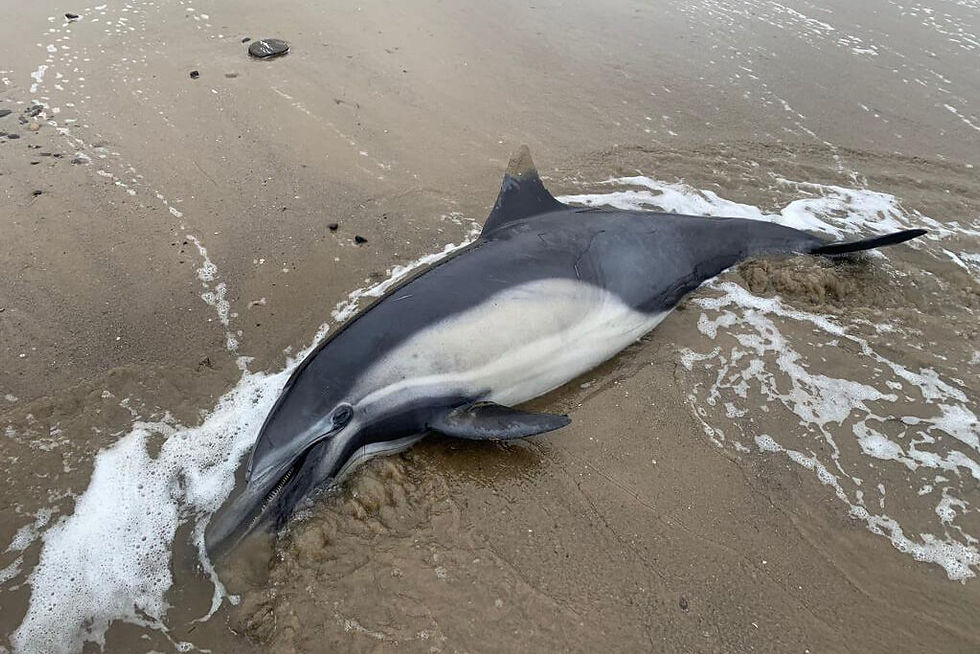
Dolphins, Dogs and Algae
During the opening week of May 2026, the Pacific waters off the shore of San Clemente’s North Beach sparkled like sapphires to the soundtrack of gently rolling waves; as beachgoers inhaled the scent of the sea perfuming the air and left their footprints in the sand. What onlookers saw next caused shock and fear: a bottlenose dolphin only partially submerged in breaking water appearing to be under the influence of a seizure. Although the growing crowd felt helpless; Los Angeles’s Pacific Marine Mammal Center rushed to the scene but were unable to be of assistance as the dolphin had been swept back to the deeper waters of the Pacific; now swimming erratically. Human intervention was fruitless and equally heartbreaking as this was the second dolphin in distress in mere days.
The charming Venice Canals (Los Angeles) boasts colorful condos, wooden bridges and small docked boats awaiting passengers to glide down its channel making the Venice Canals the ideal picturesque walk for the four-legged best friends of the neighborhood. As these pups trotted around the canals enjoying their dog day out in early 2026; later reports came in of several canines suffering from seizures, vomiting, diarrhea, liver failure and even unexplainable death; turning the Venice neighborhood upside down in alert mode.
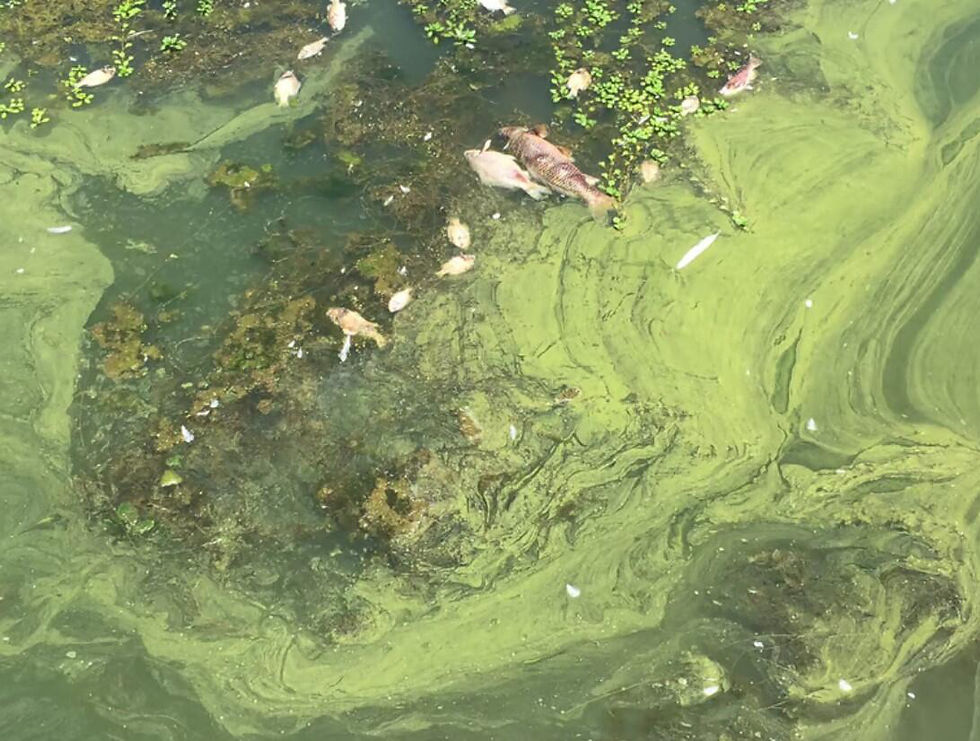
Geographically-distanced coastal neighborhoods, two distinctly varying animals: what is the Sherlock-ian clue knotting these alarming events with one string? Harmful Algae Blooms: preferably monikered to ocean scientists under the acronym, ‘HAB’. Although a world-wide oceanic occurrence; California’s coastal waterways have been cursed with dismaying HAB events especially in recent years with the 2024 and 2025 spring/summer seasons being some of the worst on historical record. In a 2026 reversal, the algae toxins are comparatively minimal allowing for some breathing room for marine rescuers and ocean conservationists - but California is not entirely out of the flagged stage.
What are HABs and How Do They Impact California?
Algae are the ‘trees of our oceans’ helping to photosynthesize carbon, serve as food for a significant number of sea animal species and structurally secure the marine sediment beds. Without algae; our entire oceanic ecosystems would be awry with a global land and air decompression. These superheroes of the ocean can, periodically, become the villains influenced by warming waters and offshore runoff causing algae numbers to over-multiply uncontrollably resulting in a mass disturbance. Algal blooms occur as water rich in phosphorus and nitrogen nutrients (usually entering the waterways through pollution or California’s infamous wildfires) is pushed in a circular motion upwelling speeding the growth of Pseudo-nitzschia: a single-celled alga. Pseudo-nitzschia produces a by-product of the neurotoxin, domoic acid. When the conditions are idyllic for a HAB to take place, then the entire oceanic ecosystem and food chains are violated by an overabundance of the uninvited domoic acid party guest.

Acting as the superfood of plankton, sardines, fish and shellfish; algae is in turn consumed by the mammals of the sea: pinnipeds like seals and sea lions, dolphins, whales and sharks. The toxic domoic acid hijacks the host animal’s spinal fluid causing brain damage and eventual death. In the spring HAB event of 2025, Southern California’s multiple marine wildlife rehabilitation facilities received up to 100 calls a day regarding domoic acid-affected animals taxing out their physical space and financial grants rushing to save those dying. HAB events are not only the seasonal killers of ocean life; but actively cost the US economy millions yearly in marine waterway infrastructure damage, income loss, and even tourism and recreational dents.
Although climate change warming the waters of our oceans is one of the primary causes of HAB events; algal blooms are not a modern-day phenomenon dating back to as far as 2.5 billion years when blooms blanketed the fledgling earth’s surface waters causing ‘The Great Oxidation Event’ which, quite literally, made life possible with the introduction of prosperousamounts of oxygen. During the Devonian Period (419-358 million years ago), the loosening roots of trees and plants triggered the unhinging of boulders and rocks thus releasingnutrients into the water systems causing an algae bloom that devoid the oceans of so much oxygen that most marine mammals became extinct. The famous Chicxulub asteroid extinction of dinosaurs recited by school children worldwide;also resulted in seven notorious HAB events only recently confirmed by scientists running simulations of ocean productivity before and after the asteroid impact. The asteroid’s blocking of sunlight and monstrous release of dust dramatically cooled the seas causing the upwelling of nutrient-dense water which is the homeostatic condition ideal for a HAB event. Turn back 47 million years when modern-day Germany experienced a HAB event that was the genocide of horses, bats and birds. Subsequent notable devastating HAB events occurred 2.6 million years ago in the Gulf of Florida, 1000 B.C. in Egypt, 1606 and 1774 respectively in Vanuatu, Spain, 1793 in British Columbia, Canada, 1799 in Alaska and 1844 in Florida.
California is no stranger to historic HAB events with 1927 seeing the San Fransico Bay area tragically reporting six human fatalities and several hundred more becoming sick afterconsuming shellfish high in domoic acid.

Fans of the horror-king Alfred Hitchock might be surprised to learn that his inspiration for the classic film, “The Birds”, was that of a Monterey Bay, California disturbance in 1961 with thousands of birds acting erratically and dying in mass numbers which has since been verified to be the result of a Pseudo-nitzschia bloom. HAB events in California are now larger in spread scope, last longer in duration and travel to more waterways than ever before.
Marine or land animal species consuming seafood from algae-infected waters are principally those to succumb to the evil end-game of HAB events but humans can also experience symptoms such as nausea, diarrhea, lung infections, eye irritation, vomiting and seizures from swimming in bloom-infected waters or engaging in water sport recreations. Although rarer, humans can become afflicted with Amnesic Shellfish Poisoning (ASP) from consuming mussels, clams, scallops and oysters high in domoic acid seeing memory loss, headaches and even death.
Golden Mussels in the Golden State: The Hidden Side of Algal Blooms Effecting Consumers and the Food Chain
HAB events are the deadly nemesis to California’s marine life but they are also the evil foe to the state’s agriculture, infrastructure, drinking water and even the Californian end consumers of the food chain. To understand this negative feedback loop of algae blooms we must rewind to the fundamental building blocks. When a HAB proliferates, Pseudo-nitzschia concentrates the vicious domoic acid which infiltrates the consumers of this alga like sardines, anchovies and filter-feeding bivalves: the group of mollusks comprising of mussels, clams, oysters and scallops. When these animals are eaten by lobsters and crabs; suddenly California’s food supply is restricted: fisheries close, jobs are paused at seafood processing plants and the public consuming these animals as food are at risk of domoic acid intoxication that can inevitably lead to severe health complications and even death.
The biggest threat to the human food chain are the bivalves which causes the State of California Department of Public Health to yearly suspend the consumption of sport-caught California coastal mollusks between May 1 – October 31 in order to prevent an outbreak of Amnesic Shellfish Poisoning (ASP) or Paralytic Shellfish Poisoning (PSP). Commercially-caught bivalves are rigorously tested and considered to be much safer to public health but still meant to proceed with caution. Mollusks strategically consume plankton releasing nutrients into the water making algae thrive; while also over-filtering compounds that allow excess sunlight to bloom the algae in addition to imbibing on their own dose of domoic acid. This evil acid accumulates in the innards of these animals which unless removed before eaten; has disastrous results.
California is being attacked from both sides during HAB events as the state is currently under a State of Emergency declaration due to the infestation of Golden Mussels: a highly invasive filter-feeding mussel species native to Asia with a massively-rapid expansion rate currently causing devastation to California’s waterway infrastructure by clogging pipework and tanks, damaging structures, constricting drinking water flow capabilities, disturbing water-suppression systems which are critical for California’s wildfire response, damaging water integrity, shrinking California’s native fish populations and terrifyingly: speeding the growth of algae blooms.

These Golden Mussels are impenetrable appearing to be able to withstand a nuclear apocalypse with California’s engineers, water experts, scientists and biologists working around the clock to find a solution of complex Golden Mussel management or annihilation. Golden Mussels have already wreaked havoc in Northern California damaging a $100 million floodgate in Kern County, damaging Santa Clara water treatment facilities and a raw water processor in Santa Teresa. “This is no longer a theoretical concern or something happening elsewhere. The infestation is here”, confirms Thomas Brown, Kern County Intergovernmental Affairs Officer. Experts recommend visiting the California Department of Public Health website for up-to-date information regarding domoic acid contaminated seafood/algae bloom maps before consumption. (https://wildlife.ca.gov/fishing/ocean/health-advisories)
California Moving Forward and Monitoring HAB Events
California fundamentally focuses on providing both public and private sectors with real-time HAB updates and offers a host of key resources to combat risks to oceanic or human lives. Implemented in early 2025, the United Nations began collaboratively working with California using satellite data and images to highlight water upwelling and movement, the presence of algae, temperature changes, and miscellaneous anomalies to help warn of incoming HAB events. Environmental scientists in the San Francisco Bay area along with the US Geological Survey California Water Science Center partner to analyze water data including water movement, temperature and microbial life in agal communities helping to slow spread. The National Oceanic and Atmospheric Administration (NOAA) also works hand-in-hand with California state authorities providing the use of satellites and ocean sensors hoping to mitigate the growth of devastating blooms. The State of California Water Control Monitoring Council provides the public with an easy-to-use incident reporting info-graphic map that showcases any threats, warnings, cautions, bloom confirmations, sightings and alerts (https://mywaterquality.ca.gov/habs/resources/reports-map/). These agencies working together are a critical asset to the wellbeing of California’s marine life and public health.
Although scientifically impossible to completely eradicate HAB events; California state officials are using innovative methods to help manage blooms preventing them from causing chaos to the state’s sea life, economy, public health and food chain. California implements approved algaecide that significantly reduces the coverage of blooms; while also introducing clay sprays to the surface of water. These sprays bind with algae sinking to the sea bed and neutralizing them. The clay method can be observed by the pilot program at Clear Lake in Northern California where phosphorus, one of the key nutrients of blooms, is removed and force-fed into the sediment layer. Experts via the state’s Regional Water Boards also increasingly focus on altering oceanic environmental conditions by extinguishing the access of oxygen that feeds blooms and enforcing “maximum daily load” numbers capping the nutrient amounts that can be flushed into the waterways. Even droids are entering the HAB fight with Imaging-Flow Cytobots created by the Ocean Protection Council, transmitting underwater microbial data in real time. These combined efforts will profoundly ensure that California’s marine life, public health and economy remain preserved.
If encountering an animal suspected of being intoxicated by domoic acid, remain at least 50 feet in distance and immediately call any of the following agencies:
NOAA West Coast Marine Mammal Stranding Network at 1-866-767-6114
Channel Island Marine & Wildlife Institute at (805) 567-1506
California Wildlife Center at (310) 458 - 9453
Pacific Marine Mammal Center at (949) 494-3050
Marine Mammal Care Center Los Angeles at (424) 450-0570
Directories / Credits
1: “Dead Dolphin and Distressing Video Raise Concern in Orange County”, Written by Lilly Dallow. Published on May 7, 2026 by KTLA 5Los Angeles.
2: “Navigating the 2026 Toxic Algae Venice Canals Crisis: Protecting Your Dog on the Westside”, Written by Arnold Lopez on February 25, 2026 by Puparazzi Pet Resort and Spa. https://puparazzila.com/blog/2026-venice-canals-toxic-algae-bloom-dog-safety/
3: “Algal Blooms”, Written by Gary Pitzer. Published on Unknown Date by California Department of Water Resources.
4: “Harmful Algal Blooms”, Written by Uknown Author. Published on Unknown Date by Tracking California.
5: “Understanding Harmful Algal Blooms in California”, Written by San Diego Coastkeeper. Published on June 10, 2025 by San Diego Coastkeeper.
6: “Asteroid Impact in Earth’s Past Caused Brief Bloom of Algae and Substantial Ocean Species’ Extinction”, Written by Unknown Author. Published on June 17, 2021 by Potsdam Institute for Climate Impact Research.
7: “Historical Occurrence of HABs”, Written by Unknown Author. Published on Unknown Date by U.S. National Office for Harmful Algal Blooms.
8: “'The Infestation is Here': Another California County Declares Emergency Over Species”, Written by Gillian Mohney. Published on May 14, 2026 by San Franscico Gate.
9: “Harmful Algal Blooms and Wild-Caught Seafood in California”, Written by Carolynn Culver, Carrie Pomeroy, Joe Tyburczy, Theresa Talley, Katherine Leitzell, Tatiana Raskin, Fernanda Pett, Junnichi Mijares, Danielle Punsal, Jae Shim and Sarah Amiri. Published on January 22, 2019 by Sea Grant California.
10: “California as Ground Zero for North America’s Golden Mussel Invasion: What to Know About the Mussel that has Already Triggered a State of Emergency in San Joaquin County”, Written by Lane Klansek. Published on May 4, 2026 by GEI Consultants.
11: “Hitting Us Where it Hurts: The Untold Story of Harmful Algal Blooms”, Written by Uknown Author. Published on September 25, 2024 by National Oceanic and Atmospheric Administration.
12: “Behind the Data: Observing California’s Toxic Algae from Space”, Written by Unknown Author. Published on February 24, 2026 by Eumetsat.
13: “Heterosigma Akashiwo San Francisco Bay”, Written by California Water Science Center. Published on February 4, 2026 by United States Geological Survey.
Strategic Partnerships
Reel Guppy Outdoors
SharkedSkooler
Marine Enthusiasts Podcast
Cash Daniels
Tides of Tomorrow
The Open Book, Topanga
Olivenbaum Music
Pitfire Artisan Pizza
Three J’s Kitchen
Our Loyal Patrons
P. R. Ochoa


This is another informative article, It’s amazing how something like algae can affect an entire ecosystem. HABs are a concern for us who enjoy Lake Erie from July to October. I’ll be awaiting the National Centers for Coastal Ocean Science’s HAB forecast as bloom season begins!