
The Blue Shark of Saint Jean De Luz, France (Prionace glauca)

Updated: May 11
This month’s article series will discuss Saint-Jean-de-Luz, France. Saint Jean De Luz is a small fishing town in the center of the Bay of Biscay, along the Western Coastline of France. Its name is derived from Saint Jean, & the fact that the city was flooded often over its centuries of existence. Saint Jean De Luz means “Saint Jean’s Swamp”, as the town occasionally is flooded to the point of being partially underwater. It is near the border between France & Spain, in the Basque Region.
The city itself is approximately 7 square miles, with a population density of roughly 2,000 people per square mile. The city is well known for its fisheries, wildlife, beaches, casino, spas, & luxurious resorts. Both international & domestic tourists flock to the area seeking relaxation, & a tranquil atmosphere. Many festivals & events are held in the town, as it is an accessible location to both the French, & the Spanish.
The coastline around the city is the site of many fisheries, & marine animals. One of the marine animals that thrives in these waters, is the Blue Shark (Prionace glauca).
The Blue Shark is a species of requiem shark that inhabits both temperate & tropical waters worldwide. Individuals are found as far north as Norway, & as far south as central Chile. They are named for their blue skin. They are known to feed on squid & small fish. Generally, they live in shallow waters, but they are able to survive in waters as deep as 1,575 feet.
The meat of the Blue Shark is heavily sought after in the Mediterranean, though it is high in mercury, lead, & various harmful heavy metals. Additionally, their skin is occasionally used for leather, & their fins are sought after for use in shark fin soup. Aside from this, their relationship with humans is generally positive.
In this article, we shall discuss the discovery & life of the blue shark, the mating strategies of the blue shark, the distribution of the blue shark, & the scientific details of the blue shark. With that being said, let us delve into the blue shark.
The Discovery & Life of the Blue Shark
The blue shark was described in 1758 by Carl Linnaeus, a Swedish taxonomist, naturalist, biologist, & zoologist. Individuals can get up to 13 feet long, but they often only reach 10 feet in length. They are able to reach a hefty 401 pounds, however, they often weigh far less. Rarely, female specimens have been recorded weighing up to 862 pounds. There is slight sexual dimorphism between females & males, with females being larger. Although the lifespan of the blue shark is not clear, it is hypothesized to be between 17 & 23 years.
Blue sharks are fantastic communicators, & are intelligent animals. They are generally very friendly animals, & are considered to be mild-mannered sharks. While Individuals are typically not aggressive towards humans, there have been cases of them attacking divers unprovoked. Between 1850 & 2026, there have been 13 recorded bite cases, 4 of which were fatal. Aside from these rare cases, they typically do not interact with humans in the wild.
Blue sharks are one of the most social species of requiem sharks, often congregating in small groups to go hunting. Individual sharks do not have individual territories, & tend to migrate often. They are not territorial animals, & are usually not aggressive towards each other. Sharks swim by continuous undulations of their body, meaning that they repeatedly move themselves side-to-side, which propels them forward.
If faced with a threat, they are able to swim up to 43 miles (69.2018 kilometers) per hour to avoid being caught. They are incredibly agile animals, & can move through the water column with quick ease. Sharks are able to remain buoyant by storing extra oil in their livers, which is lighter than the water around them.
Individuals are able to sleep by turning off only half of their brains. They must keep the majority of their brain active, such that if a threat approaches, they can react to it quickly & save themselves. Unlike certain other requiem sharks, they do not have a ram ventilation system, meaning that they do not need to have water constantly flowing over their gills to remain alive. They are able to stop swimming while still absorbing the oxygen from the water.
The blue shark is a carnivore, & its diet consists of squid, small fish, octopi, lobster, shrimp, crab, & occasionally seals. They are not cannibalistic at any time in their lives. Their metabolism is very efficient, meaning that they are able to turn stored carbohydrates into energy easily. Their methods for locating prey are also incredibly efficient, with 3 major methods for locating prey. Individuals are able to find prey through smell, sight, & electromagnetic fields.
Due to their large size, very few animals even have the ability to prey upon them. Their primary predators are other large shark species, & orcas.
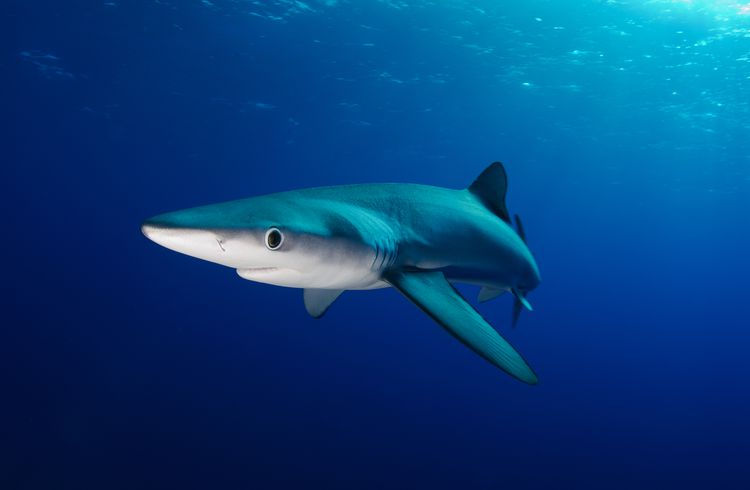
The blue shark has a long, slender, streamlined body, with a sharp conical nose. They are known for their large eyes, light blue skin, & narrow pectoral fin. As of 2026, they are categorized as Least Threatened by the IUCN Red List. Their population was found to be decreasing globally, with this last assessment being on November 6th, 2018.
The Mating Procedures, Practices, Strategies, Techniques, Tactics, & Habits of the Blue Shark
Blue sharks breed via internal fertilization, & have 2 distinct sexes. They are not naturally hermaphroditic. Their breeding system is polyamorous, meaning that each breeding season, both male & female sharks will have different breeding partners.
Male individuals seem to reach sexual maturity at 4 to 6 years of age, while females mature slightly later at 5 to 7 years of age. It is not clear how often breeding occurs, the most births that we are aware of occur from December to April. For the children to be born on time, breeding would likely occur from January to August. Their gestational period is between 9 & 12 months depending on conditions. It is not clear how copulation is initiated, however is known that they breed via internal fertilization.
After copulation, the male will swim off, having no more part in the children’s or mother’s life. Females are viviparous, meaning that they give live birth & the children gestate in their uterus, instead of in an egg. Once the female is ready to give birth, she will swim to shallower waters, & have her sharp pups.
This species is renowned for the large number of babies they have in each litter, which ranges from 25 to 100 pups. After birthing her children, the female will go to deeper water, leaving the children to fend for themselves.
The Distribution of the Blue Shark
Blue sharks are found in most temperate & tropical waters worldwide. As of 2026, they are found as far north as Northern Norway, & as far south as Central Chile. They are found in at least 3 of the 5 oceans. Although they prefer shallower coastal waters, they are found at depths of up to 3,280 feet. They are migratory animals, & frequently migrate long distances.
The Scientific Details Of The Blue Shark
Blue sharks have approximately 14 teeth on their upper jaw, & 13 to 15 teeth on their lower jaw. Their teeth are sharp, pointy, & triangular, making them efficient for ripping fish apart. Sharks do not have traditional bones, & they instead have cartilaginous skeletons. As a species, they have existed for at least 5.3 million years. As of 2026, we could not find any records of fossilized blue sharks.
Similar to humans, Great Blue sharks have various kinds of parasites. Their primary internal parasites are nematodes, which infect their intestines, & their primary external parasites are copepods, which infect their skin & their gills.
Their phylum is Chordata, meaning that they developed these 5 characteristics all species under the phylum of chordata develop 5 similar characteristics either in adulthood or as juveniles. The characteristics that they develop include, a notochord, dorsal hollow nerve cord, endostyle or thyroid, pharyngeal Slits, & a post-anal tail.
Their class is Chondrichthyes. This is a class of fish that is primarily composed of cartilage. This class can be compared to the class Osteichthyes, which is a class of fish that are primarily composed of bone. A few universal characteristics for any fish in the class Chondrichthyes is that they all are jawed vertebrates, they have paired fins, paired nares, scales, & a heart with chambers in a series.
Their order is that of Carcharhiniformes. This order has approximately 270 species categorized under it, & is characterized by two dorsal fins, anal fins, & five gill slits.
Their family is that of Carcharhinidae, which are commonly known as requiem sharks. The majority of these sharks are found in tropical areas. This family of sharks has existed since at least the Valanginian age.
Their genus is that of Prionace. Their genus is monotypic, meaning there is only 1 species belong to it. Their binomial name is Prionace glauca.

Directories / Credits
Citation No. 1: “Blue Shark”, Written by the Editors of Encyclopedia Britannica, & Published on May 27th, 1999. Published by Britannica. Retrieval Date: May 19th, 2024.
Citation No. 2: “Blue Shark: Prionace Glauca”, Written by Unknown, & Published at an Unknown Date. Published by the Atlantic Shark Institute. Retrieval Date: May 19th, 2024.
Citation No. 3: “Blue Shark: Prionace Glauca”, Written by The Accessors For The International Union For The Conservation Of Nature, & Last Updated November 6th, 2018. Published by the International Union For The Conservation Of Nature. Retrieval Date: May 19th, 2024.
Citation No. 4: “Blue Shark: Prionace Glauca”, Written by Unknown, & Published at an Unknown Date. Published by Oceana. Retrieval Date: May 19th, 2024.
Citation No. 5: “Spiral valve parasites of blue & common thresher sharks as indicators of shark feeding behaviour and ecology”, Written by Antonella Preti, Ken MacKenzie, Kate A. Spivey, Leslie R. Noble, Catherine S. Jones, Ralph G. Appy, & Graham J. Pierce, & Published on April 26th, 2020. Published by the Journal of Fish Biology. Retrieval Date: May 19th, 2024.
Citation No. 6: “Blue Shark Facts: Size, Habitat, Reproduction“, Written by Anne Marie Helmenstine, & Published on January 22nd, 2020. Published by ThoughtCo.
Strategic Partnerships
Reel Guppy Outdoors
SharkedSkooler
Marine Enthusiasts Podcast
Cash Daniels
Tides of Tomorrow
The Open Book, Topanga
Olivenbaum Music
Pitfire Artisan Pizza
Our Loyal Patrons
P. R. Ochoa


Comments