
The Pacific Tide: Poaching & Trafficking in California’s Waters


California’s Pacific coast is one of the most biodiverse and abundant ecosystems worldwide teaming with almost 2,000 species of microorganisms, plants, fish, marine mammals, turtles, invertebrates, and seabirds supported by a Mediterranean climate. Its famous offshore, underwater, and coastal rock formations date back to the Cretaceous period and help subsidize this special bionetwork making the state’s ocean waters and sea life sacred and unique.
Unfortunately, California’s precious coastal ecosystem also faces massive threats in the vein of climate change/global warming, the devastation of kelp forests, ocean acidification, algal blooms, and habitat destruction; sounding the alarm for the time-sensitive need for human intervention, conservation management, and awareness.
The Pacific Tide series highlights monthly oceanic events occurring on the California coast and/or portraits important species who call the Pacific coastline waters home emphasizing the importance of conserving this critical ecosystem.
In this month’s installment of The Pacific Tide, we expose the dark world of wildlife trafficking and poaching rings with marine and aquatic animals being highly coveted; citing examples of a 500-sea specimen trafficking bust, multiple episodes of abalone poaching, and illegal clamming among others. Learn how this unlawful activity damages the California coastal oceanic ecosystems, causes disease, endangers food web resilience, harms fisheries/ocean farming, undermines marine conservation efforts, and injuriously traumatizes the laundered specimens.
We also explore how the state of California is combating wildlife trafficking and poaching with the founding of a statewide confiscations resource network, laws enacted to protect both wild and sea life, and how the general public can get involved to help report trafficking and poaching.
2,000 Marine Animals…Inside a Box Truck?!
Mouths taped shut, secured inside everything from toys to food containers to human bodies; multiple plane rides enduring turbulence, temperature changes, and atmospheric elevation alterations, boat trips on choppy waters, and an absence of food, water, or even space to properly move… This might sound like the plot of the next kidnapping/crime documentary to air on Netflix; but it is the traumatic reality of animals laundered in wildlife trafficking rings. Archetypally, wildlife trafficking is associated with exotic animals such as monkeys and tigers; but even more lucrative and statistically significant are the illegal marine/aquatic pet trade and restaurant delicacy trafficking with the endpoint bullseye based in Los Angeles, California. It is here, at either the Los Angeles International Airport (LAX) or at the world-famous San Pedro and Long Beach Harbor Ports; that trafficked sea life - often traveling from as far as Fiji, Indonesia, the Caribbean, Australia and other far-flung dots on the map - are smuggled into the City of Angels attempting to anonymously slide past wildlife agents tasked with intercepting animal trafficking that can foreseeably damage the California coastal oceanic ecosystems, cause disease, endanger food web resilience, harm fisheries/ocean farming, undermine marine conservation efforts and injuriously traumatize the animals being laundered.
On June 19th 2026, Los Angeles-based U.S. Fish and Wildlife Service (USFWS) officials clocked into their work shifts expecting the usual chaos that comes with inspecting endless crates, boxes, products, transportation vehicles, and even the bodies of travelers; watching for illegally trafficked marine/sea wildlife. This particular Friday was unknowingly going to send shock waves into the weekend as a box truck carrying 2,000 endangered and near-threatened species of marine animals was intercepted and seized by wildlife agents. Ocellaris clownfish, rabbitfish, yellow longnose butterflyfish, lemonpeel angelfish, emperor angelfish, Banggai cardinalfish, powder blue tang fish, bamboo sharks, brown-banded sharks, crabs, shrimp, clams, turtles, aquatic invertebrates, corals, sea cucumbers, sea anemones and snails, among a host of other marine species; were smuggled into cramped spaces and inside small, cloudywater-infested tanks/ bags suffering from dehydration, injury, parasites, stress-induced trauma and weight loss resultant from lack of food during their harrowing journey. “These animals are likely from [the] reef, and that means that all animals that live in nature have some level of parasites,” Nate Jaros, Vice President of Animal Care at the Aquarium of the Pacific in Long Beach, California clarified, “And when you bring them into a stressful environment, those parasite loads can start to increase. Those fish are going to need medical treatment to ensure that we can rid them of parasites that are also compromising their health”. Heading to either illegal pet trades or restaurant consumption; this intercepted truck caused an urgent logistical and legal nightmare for the city of Los Angeles.
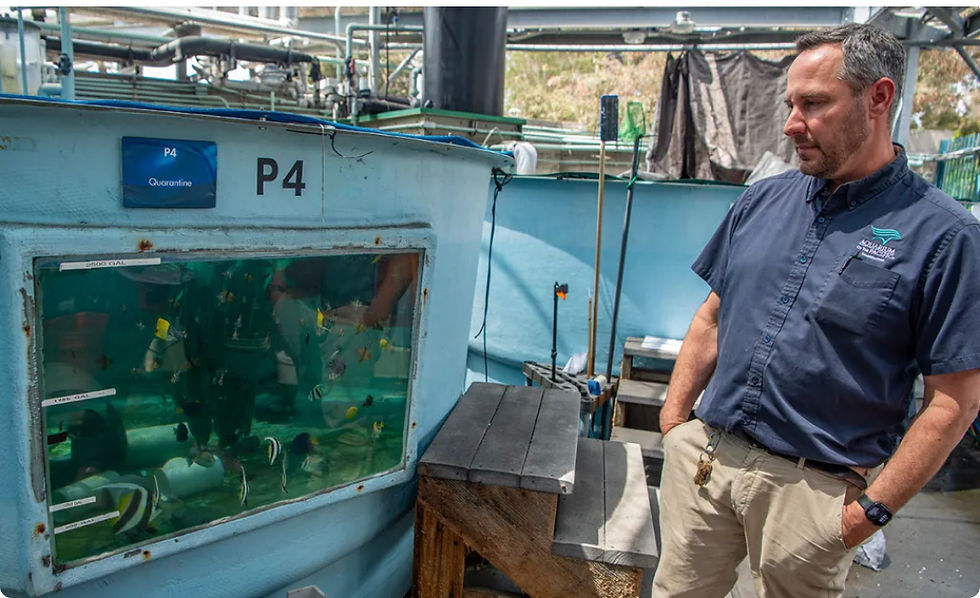
Los Angeles’s Aquarium of the Pacific (Long Beach) swooped in like superheroes taking on 500 of these trafficked sea creatures and logging/categorizing the entire truckload while triaging physical and medical conditions. Aquarium staff and veterinarians worked into the dawn hours of the early summer weekend, providing intensive care to the hundreds of seized oceanic animals now in their custody and stabilizing them in quarantine tanks hoping to recuperate the confiscated creatures and either send them onwards to other accredited ocean rehabilitation centers or integrate them into their own Aquarium of the Pacific habitats. A quarter of the laundered sea animals were discovered deceased immediately upon intake or shortly after unable to overcome their fast-debilitating medical conditions.
Due to the unverifiable origin of trafficked marine life and their weakened immune systems; these precious animals suffer the unfortunate fate of losing their freedom as release into California’s Pacific waters is impossible, attributed to the potential disruption to steady marine ecosystems and food webs. With many of the 2,000 truck-bound smuggled sea specimens being endangered species or on marine conservation lists; this means extra precautions and considerations were legally required. Aquarium of the Pacific President and CEO Jeff Flocken describes, “Wildlife trafficking disrupts national and global ecosystems and puts animals on the path to extinction. We are proud to answer the call to help trafficked wildlife and are committed to providing immediate care and a sanctuary for all of those that we can help”.
The June 19th Truck Fiasco may sound unusual and catastrophic but wildlife trafficking specifically of ocean marine animals is commonplace, standing only behind drug and human trafficking with Los Angeles being the epicenter of North American operations. In July, a further 300 marine animals found a home at the Aquarium of the Pacific from an additional trafficking incident. Since 2023, the Aquarium of the Pacific has housed more than 3,000 trafficked ocean specimens with Los Angeles seeing more than a dozen sea life confiscations by August 2026 on track to topple previous records. Corals confiscated as freight at the Los Angeles International Airport (LAX) comprise a significant portion of trafficked sea life into the United States and are especially problematic as coral species number in the thousands and often require microscopic examination to identify. While the transport and trade of sea animals isn’t entirely illegal; it is a detail-oriented system of permits, regulations, laws, and dotted I’s and crossed T’s; with endangered and threatened species being exceptionally prohibited but in great demand on the black market. However, it isn’t just trans-international animal trafficking threatening harm to California’s oceanic environment but something closer to home: poaching.
Leave California’s Abalone, Alone!

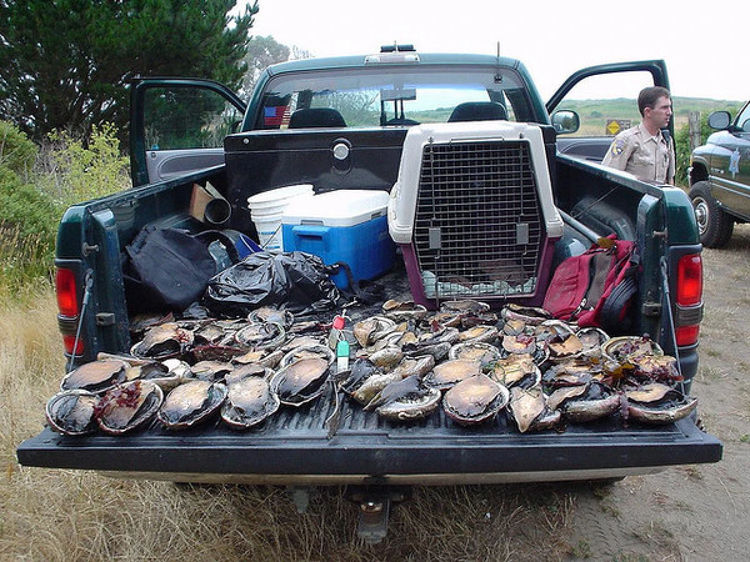
Los Angeles, California may be a premier vacation destination; but Los Angelinos often desire to escape from the bustle and heavy, grey smog. For that end, residents can board an hour-long ferry ride (22 miles) to Santa Catalina Island, one of California’s Channel Islands distinguished for its European resort ambiance, Art Deco architecture, crystal blue bays, and vibrant wildlife. Underneath this tranquil beauty lies the seedy underbelly of Catalina: poaching. Catalina is the home to an enormous natural population of the marine water snail, abalone. Red, black, green, pink, and white abalone varietals are among the highest-demand seafood cuisine delicacies but are heavily protected in California where treasured abalone are critically endangered due to overfishing, their snail-speed growth cycle (pun intended), and disease-related population wipeout. Although it is illegal to take or possess abalone anywhere along the California coast with the exception of approved sustainable fisheries during pre-selected seasons; this doesn’t stop poachers who are more fixated on the $150 average return per abalone on the restaurant black market than California’s wildlife laws. Diabolical poachers often steal abalone from Catalina’s waters under the glow of moonlight alongside cliffs and bluffs that are difficult for policing wildlife officers to monitor even in the brightest sun.
California Department of Fish and Wildlife (CDFW) agents responded to a September 6, 2026 report at Catalina’s Alamitos Harbor involving three suspects seen poaching for green abalone undermining the island’s abalone conservation efforts. Only one suspect freely admitted to the poaching and was released with a lax promise to appear in court. Not all abalone poachers are so lucky when caught by CDFW officials to walk away with a slap on the wrist. Hee Won Chai and Jin Chai Jeong, both from the Los Angeles metropolitan area, pled no contest to the taking of eight pink abalone, three green abalone, and four spiny lobsters (outside of lobster fishing season) off the shores of Catalina and to the tampering and destruction of evidence resulting in the permanent annulment of both men’s fishing licenses and $62,000 fees directed to each suspect with some of the proceeds going to the CDFW’s abalone preservation fund.

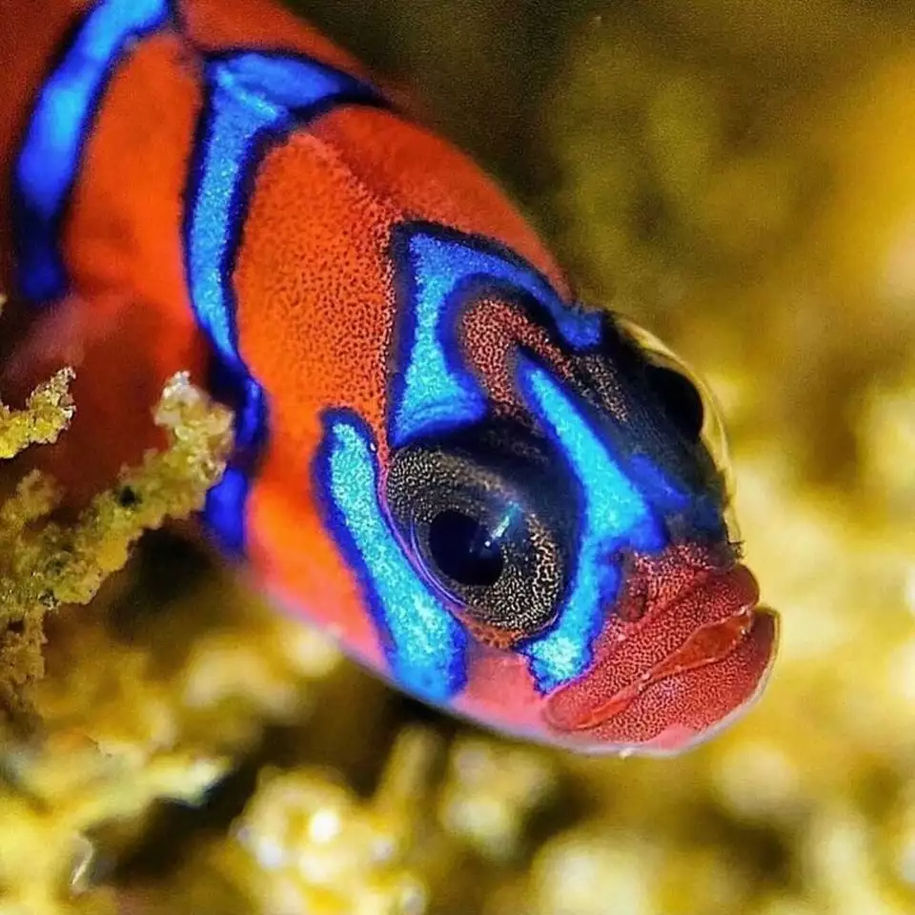
Catalina’s poaching rings encroach on other marine life outside of abalone with poachers increasingly targeting rare fish positioned at the illegal exotic aquarium market. David Hornbaker, a convicted poacher with a long list of previous infractions, was spotted by CDFW agents in Catalina’s harbor squirting quinaldine (a chemical anesthetic used to stun marine life before capture) at schools of blue-banded and zebra-banded goby fish – a practice that is illegal in the United States although regularly-practiced in other parts of the world. Hornbaker was caught in the act underwater with squirt bottles and containers while attempting to abandon the evidence and unconvincingly claimed to be unaware of the laws he was already cited for multiple times dating back to 2013. Officials counted 172 gobies in Hornbaker’s possession which, at the going rate of $5,000/fish on the aquarium black market, could have yielded an $860,000 profit had the CDFW not intercepted (the gobies were released back into the Catalina waters after the recorded count). This incident STILL didn’t stop Hornbaker who was caught yet again partaking in his life of poaching crime when Santa Cruz Island officials identified Hornbaker with the possession of rockfish without a license and the failure to list sea cucumbers (also a restaurant black market delicacy) on a dive log. Hornbaker was finally struck down when he pleaded guilty in the California Supreme Court of Law for the Catalina goby fish episode but was only charged with a misdemeanor and a measly $115 fine. However, the CDFW did rescind all of Hornbaker’s fishing licenses and confiscate all of his equipment; since then, Hornbaker hasn’t been seen again.
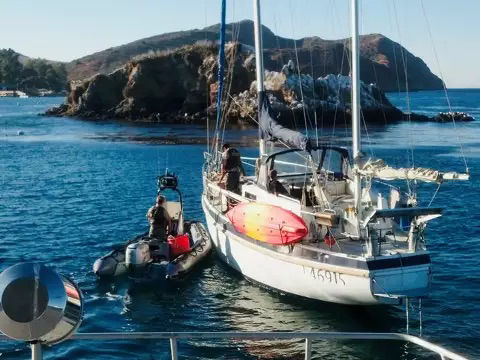
Poaching isn’t limited to the confines of Catalina Island with criminal activity buzzing up and down the California coast. A recent San Diego, California abalone incident spanned enough twists and turns and characters of interest that a game of ‘Clue’ would be put to shame. San Diego’s upper echelon, private San Diego Yacht Club (SDYC) was caught in a scandalous confrontation when a hot tip was reported of men poaching abalone and lobster from a ship registered to a top SDYC elected commodore. The boat was empty of persons of interest but shucked abalone and scuba gear were strewn about the boat decks. Officials later discovered Kyle Clark and Jesse James, both members of SDYC, on another boat; admitting to the abalone and lobster poaching. Both suspects faced $164,000 in fines and darkened the reputation of the SDYC.
An abalone poaching incident was also documented off the Mendocino, California coast in the early months of 2026 when CDFW wardens spotted a male and female duo poaching purple sea urchins with the female suspect then concealing abalone down her pants in what seemed almost like a comedic bit in a cartoon. The woman was cited for abalone poaching and faced a potential sentence of $40,000 in monetary fees and a year in prison. Just a month prior, a poacher was intercepted by the CDFW with 15 abalone in the same Mendocino location. Mendocino is a hot spot for abalone poachers with a notable incident of 11 poachers intercepted taking 400 abalone in under 72 hours resulting in several of the apprehended poachers fleeing the country and the rest charged with $71,400 fines.
As 2026 draws to a close; poaching hasn’t slowed down with an October 3rd incident occurring overnight at Pismo Beach (12 miles from San Luis Obispo, California) with CDFW wildlife officers spotting four poachers in possession of 494 clams with two of the clam-jackers fleeing the scene (one of these two returned). Pismo clams suffer from over-harvesting leading to state conservation protections hoping to recover species population numbers. Only 16 of the 494 clams were of legal harvesting-size and none of the poachers were able to present valid fishing licenses or lawfully-mandated clamming tools/devices. The three poachers (the runaway poacher never returned) all hail from the San Francisco Bay area and were arrested and booked for multiple violations including clamming after hours (clamming is only permissible during daytime), absence of fishing licenses and clamming tools/measuring devices, the possession of clams exceeding the bag limit of 10, and the possession of undersized clams below 4 ½ -inches with the failure to return immature clams. CDFW agents successfully re-buried the clams under the 2-inch depth requirement and expect the clams to fully recover from their ordeal.
Government officials hope that criminal charges will deter future poachers as the unlawful activity has been on a steady incline in California. CDFW Assistant Chief Mike Stefanak affirms, “Successful prosecutions such as these will hopefully serve as a deterrent for anyone considering committing these crimes against the environment”. It isn’t just the law that poaching and trafficking violate; they also debilitate California’s marine ecosystems.
The Crushing Consequences of Marine Trafficking and Poaching in California
Marine poaching and trafficking might be a financially-lucrative incentivized way to land your face on a wanted poster; but it is also devastating to California’s Pacific biodiversity. Delicate ecosystems are unended, disease can grow rampant, food web resilience is threatened, conservation efforts towards native species are undermined, and existing regulated fisheries are economically impacted in the short and long term by poaching and trafficking. The widespread poaching of abalone destroys California’s marine food webs even potentially risking the entire extinction of kelp forests which would be ruinous for the Pacific. Existing marine habitats are also faced with destruction from poaching and disease spread through oceanic ecosystems by discarded trafficked sea life. Often, non-native species are detected to be released into California’s coastal waters which can be invasive to existing sea life. California boasts ecosystems unseen elsewhere in the world with 7,500 species found solely in the Golden State making it critical to maintain the intricate balances at all times. Authorized fisheries also face loss of income as poachers illegally sell sea delicacies to restaurants, which in turn can be devastating to the entire state’s economic hard line.
The United States Fish and Wildlife Service (USFWS) reported that illegal wildlife trafficking into California continues to escalate with live corals holding the top spot in demand. Some of these corals are dumped into coastal waters and become invasive to coral species already calling California home. The marine trafficking statistics are hard to ignore with 48,793 laundered animals at the California border confiscated between 2015 and 2019, comprising these corals plus crustaceans, mollusks, turtles, and fish largely due to the high demand from restaurants on the black market. These numbers have been doubling with each five-year data set with the 2020-2025 period finding 72,989 trafficked animals seized at the California border with 26,296 being endangered and protected species. Poaching and trafficking is a $20 billion a year enterprise which makes the only viable solution to nullify the demand.

California is also seeing an exponential upsurge in protected sea cucumber trafficking (100 tons confiscated between 2011-2021) bringing in a high profit as the restaurant delicacy is valued at $29.5 million. Chinese Mitten Crabs, so called for their furry claws that resemble Russian hand muffs, are consistently trafficked into California during the Chinese New Year season and have caused overwhelming damage to California freshwater ecosystems and estuarine infrastructure. Chinese Mitten Crabs that either escape or are purposely released into California’s coastal oceanic waters devastate existing marine species by pilfering food sources, consuming fish eggs, spreading marine diseases, and burrowing into infrastructure causing architectural damage. Caulerpa algae, a non-native alga trafficked for aquarium filtration systems, has overtaken native seagrass in both the San Diego and Newport Beach (Orange County) bays harming the California fish species that use the existing algal ocean carpeting as nurseries. This marine invasion not only caused environmental destruction but had a profound financial impact on California costing millions to ‘clean’ with divers having to uproot the algae by hand.
Trafficking and poaching can also impact human health with zoonotic disease (illnesses that jump from animals to humans) being prevalent in illegal trade. Trafficked turtles often carry a highly-infectious form of Salmonella that radically sickens humans upon contact.

California’s Response to Marine Poaching and Trafficking
California Department of Fish and Wildlife (CDFW), U.S. Fish and Wildlife Service (USFWS), California Fish and Game Commission (CFGC) and U.S. Department of Agriculture officials can often be found collectively seated behind hundreds of computer monitors in warehouse-sized rooms in what might look like a telemarketing call center operation but this is actually an undertaking aimed at scouring internet websites, private forums, and public online groups for the potential sale of any trafficked and poached marine specimens and any ‘viral trends’ fueling the demand for these animals. At the Los Angeles International Airport (LAX), 12 warehouses of incoming cargo are inspected all day, every day, by wildlife officials and canines trained to ‘sniff out’ illegally trafficked animals including marine species from corals to sea turtles and sharks to seahorses.
Meanwhile, wildlife officials patrol California’s 1,954-mile-long Mexico border, coastal waters bays, and more than 100 million tons of cargo that collectively enters California’s airports and harbors; but this is a behemoth task shouldered by too few staff members for the scope of the job. Wildlife inspectors were already severely understaffed; but with the current presidential administration’s piercing of funding budgets toward wildlife protections and federal layoffs of agents in the field: an additional 33% reduction in the USFWS workforce has caused a further strain. In early 2026, 5% of wildlife agencies were terminated with a further 420 layoffs pending. It is vital to find ways to counteract these weaknesses and continue to battle California’s trafficking and poaching crisis.
One of the principal holes in tackling California’s marine life trafficking and poaching; is the burden of where these animals will ‘go’ after being confiscated. Wildlife inspectors and agents intercepting traffickers and poachers heavily pursue the legal ramifications but their job description ends within these boundaries and they are often at a loss as to who to call during the critical time bomb of these animals needing immediate medical care and resources.
Launched in 2023, California established a pilot program intended to solve this dire need with the Southern California Wildlife Confiscations Network. The Southern California Wildlife Confiscations Network is a unified collaboration between the Association of Zoos and Aquariums (AZA) and the U.S. Fish and Wildlife Service (USFWS) streamlining the placement of seized animals with accredited zoos, sanctuaries, aquariums, universities, and permit-approved animal facilities on their roster. With this program, wildlife agents can quickly access vetted network members through one point of contact department; shortening the downtime between law enforcement seizures and necessitating animal care to increase the chance for survival. “Across the country, it’s always a challenge with humanely placing animals,” expressed Dan Crum, a USFWS Office of Law Enforcement Pacific Southwest Region official, “Most agents deal at the local level and do their networking within the vicinity of their points of entry. And these may not be the best places for the animals. We decided we needed a cleaner, simpler way of placing confiscated animals”. The initiative’s ocean species resource care members already include the Los Angeles Zoo & Botanical Gardens, Aquarium of the Pacific, San Diego Zoo, Oakland Zoo and the Turtle Survival Alliance with additional partners added regularly. Beth Schaefer, Director of Animal Programs at the Los Angeles Zoo and Botanical Gardens in Los Angeles, California explained the zoo’s Southern California Wildlife Confiscations Network participation, “One of the biggest problems for the agents is looking down at an animal they confiscated and thinking, ‘I don’t know what to do with this.’ They’re stressed out about how to take care of the animals because their job is law enforcement, and I realized that we could seriously help with this issue”. Even in its infancy, the Southern California Confiscations Network has been a massive success already placing nearly 5,000 trafficked live specimens into coordinated care with state government officials hoping to expand the program nationally.
California state officials also work on the legal side to dampen the demand for trafficked and poached animals with the passing of a wave of wildlife protection laws and an increase in felonious charges. California hopes that strengthening state penalties for animal trafficking and poaching making them equal to that of drug and human trafficking, money laundering, and racketeering with sentences of 20 or more years in prison and fines of $250,000 fines; will send a clear message and potentially deter criminals. California has already enacted House Bill 96 and the California Endangered Species Act (CESA), both prohibiting the sale of trafficked and poached animals and animal parts while California Governor Gavin Newsom recently authorized Assembly Bill 1319 that allocates California state funding and protections to endangered and threatened animal species after the recent federal defunding of the U.S. Endangered Species Act. The Golden State moreover bans the taking, possession, trade, and sale of shark fins.
The general public is also encouraged to mitigate poaching and trafficking through identifiable and easily-accessed methods. California urges residents not to ‘like’ or interact with social media accounts that possess exotic trafficked and poached animals, as this increases demand for endangered animals. The California Department of Fish and Wildlife (CDFW) advises residents to use CALTIP (Californians Turn in Poachers and Polluters) where anonymous and confidential reports of trafficked or poached animals can be directed either via an 800-number manned 24 hours a day, seven days a week, through text message, or a downloadable CALTIP smartphone app. As an incentive, any reports that lead to a verifiable arrest of poachers, animal traffickers, or environmental polluters result in the eligibility of a $3,500 reward to the informing individual. With the state of California and caring citizens working together; we can prevent the future trafficking and poaching of marine animals, escape further damage to California’s oceanic native species and food webs, bypass economic devastation, and obviate the suffering of laundered animals.
If you believe you have witnessed animal poaching and trafficking in the state of California, you can report the incident to authorities by using CALTIP:
• Call CALTIP at 1-888-334-CALTIP (888
334-2258) 24 hours a day, seven days a week. Be prepared to provide any and all details regarding the alleged incident. You do not have to provide your name and may remain anonymous.
• Send a text message to tip411 (847411) from your smartphone with the subject of ‘CALTIP’ followed by a space and the body of your message. You do not have to provide your name and may remain anonymous.
• Download the free CALTIP app from any iPhone or Android device where reports can be made with live two-way chat capabilities to wildlife authorities.
Directories/Credits
1: “Long Beach Aquarium Takes in Nearly 500 Trafficked Animals After Massive Seizure”, Written by Lily Dallow. Published on August 28, 2026 by KTLA 5 Los Angeles News
2: “Long Beach Aquarium Nurses Nearly 500 Trafficked Fish Back from the Brink”. Written by Sarah Kim. Published on September 20, 2026, by Hoodline Los Angeles https://hoodline.com/2026/09/long-beach-aquarium-nurses-nearly-500-trafficked-fish-back-from-the-brink/
3: “How the Aquarium of the Pacific Scrambled to Save Hundreds of Sea Creatures After 2 Massive Smuggling Busts”, Written by Long Beach Post. Published on August 28, 2026, by The LA Local
4: “Suspect Caught Poaching Abalone Near Catalina Island, Wildlife Officials Say”, Written by John Ross Ferrara. Published on September 18, 2026, by KTLA 5 Los Angeles News
5: “Poachers Fined More than $120,000 for Taking Abalone and Lobsters Off Catalina Island”, Written by Debbi Baker. Published on September 15, 2016, by The Los Angeles Times
6: “A Poaching Scandal Made Waves in San Diego’s Yacht Club Community”, Written by Ry Rivard. Published on October 18, 2018, by Voice of San Diego
7: “California Poacher Busted After Hiding Two Abalone…in Her Pants”, Written by Sage Marshall. Published on February 9, 2026 by Meat Eater
8: “Poacher Busted with $5,000 Worth of Fish by Snorkeling Calif. Officer Loses License”. Written by Ashley Harrell. Published on April 23, 2021, by San Francisco Gate News
9: “Illegal Wildlife Trafficking Affects California Animals, Too”, Written by Chris Clarke. Published on February 11, 2014, by PBS SoCal
10: “It’s ‘whack-a-mole’: Alarming Rise in Pet Trade Fuels Wildlife Trafficking into California”, Written by Spoorthy Raman. Published on November 25, 2025, by Mongabay
11: “Five Ways Illegal Wildlife Trade Endangers Our Oceans”, Written by Unknown. Published on April 12, 2024, by Oceana
12: “The Southern California Wildlife Confiscations Network”, Written by Mary Ellen Collins. Published on October 19, 2022, by the Association of Zoos and Aquariums
13: “Pilot Wildlife Confiscations Network Is Launched in Southern California”, Written by Reuters. Published on October 31, 2023, by Times of San Diego
14: “New SoCal Network Helps Save Animals Rescued from Illegal Wildlife Trade”, Written by Jovana Lara and Lisa Bartley. Published on October 28, 2023, by ABC7 Los Angeles News
15: “New Network Gives Hope to Animals Trafficked Through Illegal Wildlife Trade”, Written by Public Affairs HQ. Published on October 27, 2023 by United States Fish and Wildlife Services
16: “CALTIP - Californians Turn in Poachers and Polluters”, Written by Unknown. Published on Unknown Date by the State of California Department of Fish and Wildlife
17: “AB 1319: Protected species: California Endangered Species Act”, Written by Nick Schutlz and Tasha Boerner. Published on October 11, 2025, by Cal Matters Digital Democracy
18: “Pismo Beach Police Seize 494 Illegal Pismo Clams”, Written by Pismo Beach Police Department. Published on October 7, 2026, on Facebook by Pismo Beach Police Department


Comments