
Marine Biological Hall of Distinction: Robert T. Paine (Robert Treat Paine III)

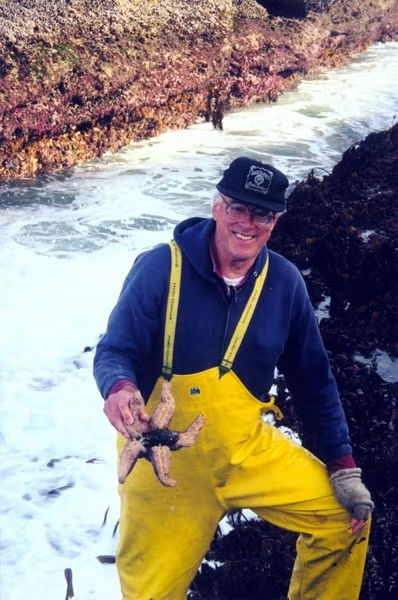
This article is part of our Marine Hall of Distinction collection. In this special collection, we discuss the marine scientists who we feel have contributed the most to marine biology & oceanography. We do this to commemorate these marine scientists & show gratitude for everything they have contributed to our oceans. Today's marine scientist is Robert T. Paine.
Robert T. Paine was an American marine ecologist, zoologist, & author. He is best known for coining the term “keystone species”, a phenomenon which occurs when a species is important to an ecosystem than its relative abundance might imply.
In today’s article, we will delve into his formative years, education, personal life, career, achievements, accomplishments, & awards. With that being said, let’s plunge into the extraordinary life & career of Robert T. Paine!
His Formative Years & Education
Robert Treat Paine III was born in Cambridge, Massachusetts, on April 13th, 1933. He is the grandson of Robert Treat Paine, the Founding Father, Revolutionary, & first Attorney General of Massachusetts.
He was born to Robert Treat Paine Jr., & Barbara Birkhoff. His father was a curator of Japanese Art at the Museum of Fine Arts in Boston. He is well known for his role in art restoration efforts in post-war Japan, & for his book The Art and Architecture of Japan (1958), which he co-authored with Alexander Soper. His mother was an accomplished writer & photographer, & daughter of the extraordinary Dutch-American mathematician George David Birkhoff.
His curiosity for the natural world was sparked at a young age. As a toddler, he enjoyed observing ants in his families driveway. As he grew older, he began exploring the wooded areas 30 miles west of Cambridge, hunting for earthworms, salamanders, mushrooms, & the like. He also enjoyed birdwatching, growing to be respected as naturalist of birds by the local Bostonian Birdwatching community of the day. This love of birding remained until his death. It is said that he could identify a bird not only by its visual markings, but by its song.
Before leaving for the prestigious Harvard University, he decided to venture on a summer road trip that would ultimately change his life, & his relationship with the natural world. Driving roughly 4,400 miles from Boston to Alaska, he spent the summer working in salmon canneries. He learned numerous maritime, exploration, & adventuring skills which would go on to serve him well in his career as an ecologist.
Upon returning, he earned his bachelor’s degree in palaeontology from Harvard University in 1954 under advisor Ernst Mayr. After a 2 year stint in the US Army, he began graduate school at the University of Michigan. After taking zoology courses under the late great Frederick E. Smith, Robert found his true passion, & switched majors to zoological studies, with Smith as his academic advisor.
For his dissertation, he decided to study brachiopods in Bay Mouth Bar, Franklin County, Florida, on the Gulf Coast. According to his own account, the young Robert arrived with “few funds, no boat, and no place to live”. Thankfully, the field station director of Florida State University Coastal & Marine Lab, Dr. Harold Humm, took him in, giving him free lodging & a boat to do research with. There, he studied the ecology, range, & habitat of local brachiopods. Later in his career, he would return to Bay Mouth Bar with a fleet of graduate students & post-docs to research the local marine life.
Finishing his P.hD in 1961, he took a post-doctoral fellowship at the Scripps Institution of Oceanography. Shortly thereafter he moved up the West Coast to join the faculty at the University of Washington, where he would stay for the next 36 years.
His Personal Life & Career
Upon joining the University of Washington, he began studying community ecology, with an experimentalist philosophy. Over the course of his career, he would contribute a multitude of concepts to the field of community ecology with his collaborators. He is credited as one of the earliest scientists to study vertical zonation in the intertidal zone. Above all, he is best known for his 1966 paper coining the term “Keystone Species”, to describe the relationship between ochre sea stars (Pisaster ochraceus) & California mussels (Mytilus californianus) in the intertidal zone. This term Keystone Species is used to refer to species in an ecosystem which are more ecologically important than their relative abundance might suggest. What this means in practice is that they sustain a vital component of the local ecosystem, & are integral for ecosystem health.

At the age of 65, he formally retired from the University of Washington, being honored with a retiree party filled with collaborators, fellow faculty, & students alike.
Unfortunately, Dr. Robert Treat Paine III, affectionately known as Bob, passed away on June 13th, 2016, at the age of 83 as a result of acute myeloid leukemia. He was survived by his daughters Anne, Susan, & Nancy, along with his former wife Alice E. Coleman. He is fondly remembered by family, colleagues, & former students alike for his remarkable dedication, enthusiasm, energy, whimsical unseriousness, & enduring body of work. Over the course of his career, he was well known as an ethical, just scientist. He was revered for his efficiency & parsimonious approach, with a high science-per-dollar ratio. Robert T. Paine will continue to influence new scientists for generations to come.

His Awards, Achievements, & Accomplishments
He coined 2 of the most important terms in community ecology, keystone species & trophic cascade. The former refers to a species having a disproportionately large ecological impact, larger than its relative abundance implies. The latter refers to an ecological interaction where upper trophic levels (predators) affect lower trophic levels. The impact of these 2 terms cannot be understated, as they both influence the field of ecology dramatically.
Over the course of his illustrious career, he received fellowships, awards, or similar honours from the following institutions: Lerner Marine Fellowship, American Museum of Natural History Fellowship (1959); Sverdrup Postdoctoral Fellowship, Scripps Institution of Oceanography (1961-1962); Third Tansley Lecturer, British Ecological Society (1979); AAAS Fellow (1980); John Simon Guggenheim Memorial Fellowship (1981-1982); Robert H. MacArthur Award, Ecological Society of America (1983); National Academy of Sciences (1986); the Ecology Institute Prize (Germany) (1989); honorary doctorate, Colby College (1996); visiting lectureship, British Ecological Society (1996); Sewall Wright Award, American Society of Naturalists (1997), American Academy of Arts and Sciences (1999); and the International Cosmos Prize (2013). We thank the National Academy of Sciences for putting this list together.
He was honored in Serengeti Rules (2016) by author Sean Carroll, with a chapter dedicated to his work on trophic webs.
He established a long-term research facility on Tatoosh Island in Northern Washington in collaboration with the local Makah Indigenous Peoples.
He led the Ecological Society of America as vice president from 1977 to 1979, before being promoted to president.
He sprouted one of the most fruitful academic families in the last half of the 20th century. He personally trained 40 graduate researchers as well as post-doctoral fellows. These researchers went on to train students of their own, who trained students of their own, growing his academic family to hundreds of individuals.

Directories / Credits
Citation 1: “Biographical Memoirs: Robert T. Paine (1933 to 2016)”, Written by Mary E. Power, James A. Estes, Peter Kareiva, Simon Levin, Jane Lubchenco, & Stephen Palumbi, & Published in 2018. Credit to the National Academy of Sciences.
Citation 2: “The “Keystone Species” Concept That Transformed Ecology”, Written by James MacDonald, & Published on June 30th, 2016. Credit to JSTOR Daily.
Citation 3: “Remembering a ‘Keystone’ Ecologist, Robert Paine”, Written by Andrew C. Revkin, & Published on July 14th, 2016, at 2:20 PM. Credit to the New York Times.
Citation 4: “Robert Treat Paine III (1933 to 2016)”, Written by Mary E. Power, James A. Estes, Peter Kareiva, Simon Levin, Jane Lubchenco, & Stephen Palumbi, & Published on June 19th, 2017. Published by the National Academy of Sciences.
Citation 5: “In Memoriam: Robert Treat Paine III (1933–2016), An Outsized American Naturalist”, Written by Brian R. Silliman, Peter Kareiva, & Catherine A. Pfister, & Published on November 4th, 2016. Published by The University of Chicago Press Journals.
Citation 6: “The Man Whose Dynasty Changed Ecology”, Written by Ed Yong, & Published on January 16th, 2013. Published by Scientific American.
Citation No. 7: “Robert Paine, Ecologist Who Found ‘Keystone Species,’ Dies at 83”, Written by Sam Roberts, & Published on June 17th, 2016. Published by the New York Times.
Strategic Partnerships
Reel Guppy Outdoors
SharkedSkooler
Marine Enthusiasts Podcast
Cash Daniels
Tides of Tomorrow
The Open Book, Topanga
Olivenbaum Music
Pitfire Artisan Pizza
Three J’s Kitchen
Presence News
Our Loyal Patrons
P. R. Ochoa
Comments