
“Remember That The People Seeing Your Content For The First Time Might Have The Same Emotion That You Had When You Had Your Idea!”, An Interview With Creator of The Mirror Without Image Rapport Erebus


Recently, our head writer interviewed the incredible Oceanic Horror Producer, & Creator of The Mirror Without Image, Rapport Erebus!
Rapport Erebus is a French analog horror producer best known for his web series Rapport Erebus, & The Mirror Without Image. The eponymous series Rapport Erebus focuses on a mysterious massive blue hole opening in the middle of the Pacific, leading to scientists discovering a behemoth of mythical proportions. His current series, The Mirror Without Image, focuses on a mysterious city underneath the Timor Sea, leading to the uncovering of a horrifying truth.
In today’s interview, we sit down with Erebus to discuss his passion for the ocean, his analog horror journey, his creative process, his eponymous series Rapport Erebus, The Mirror Without Image, & his advice to aspiring oceanic horror storytellers. Before delving into today’s comprehensive 17-question interview, please note that everything said has been edited for clarity, & that the opinions of our interviewee do not necessarily reflect the opinions & values of our organization. With that being said, let us delve into the contents of the interview!
The Contents of the Interview
Questions About His Career:
1. What sparked your passion for marine biology & all things ocean?
Well, it’s kind of a family business. My grandmother was a biologist; she was a teacher of biology at a French college, & my father was in the Navy. I do video stuff, so I’m kind of the synthesis of these 2 ancestors of mine.
2. What sparked your passion for video & motion graphics?
It was kind of an accident; at first I studied graphic design. I wanted to do some print work. It was a long time ago; I’m quite old, I’m 36, that’s old for a YouTuber. Video & motion graphics were the hot thing in 2011, & 2012. So, I started; I told myself, okay, let’s go this way, & I’ve been working in video ever since!
3. What sparked your passion for ocean / analog horror?
I think I was always a little bit scared of the ocean. There’s something weird about it, about the fact you can’t see underwater. That’s the main contact point with horror. You really can’t see 2 to 3 meters in front of you. That’s a great device for anything horror!
I’ve always loved horror movies. I saw a documentary in 2019 called Last Breath. It’s about Chris Lemons who was a saturation diver who got disconnected from his vessel. He survived 30 minutes in the darkness of the abyss. That was really my main media inspiration to start doing underwater horror stuff.

4. How did you come up with the name “Rapport Erebus”?
Rapport is just report, that’s self-explanatory. Erebus is a Greek deity, but it’s also the passage to the underworld. It’s the gate to Tartarus, & the deeper parts of the underworld. My series was about a hole found in the bottom of the Pacific Ocean. I thought Erebus would be a great name for a gate to the underworld, & there’s a lot of references to Greek mythology throughout the series. The main thing that made me want to add these references is because in France, the last nuclear atomic bomb test was called Project Xouthos, which is a Greek name.
I’m really interested in making things sound realistic. For example, I told you my father was in the Navy; I asked him for the ranks of people who would be diving. There’s Capitaine de vaisseau, & ranks like that. I also asked for the vessels used by the French Navy (Marine Nationale) at that time. I tried to make it look realistic, & to link some real elements to the story.
5. What is your favourite marine or terrestrial animal?
I’m going to be quite classic; it would be the leatherback turtle. I don’t know if it’s the graphic designer in me, but they are very aqua-dynamic. It’s a really nice design.

Questions About His Analog Horror Series:
6. What inspired you to begin creating analog horror? How did you start?
It’s very inspired by Lovecraft, & by cosmic horror. I think discovering something & finding out that everything you know might be wrong. All you think about, your history, your preconceived notions you have about how the world works. The cosmic horror angle that Lovecraft has was the main feeling I wanted to convey. Another great reference is the first Alien movie. In the first Alien (1979) movie, when they explore the derelict & find the corpse of an alien, it’s the feeling of “Okay, everything is falling apart”; that’s the kind of dread I wanted to convey.
I think Kane Pixel’s Backrooms (2022-) is what made me think I could do it. If you look at the Backrooms, the 3D work is quite simple. It’s the concept that made it work. It’s really endless rooms; it’s just a few polygons of 3D work. I’m not a very good 3D artist, but I told myself, it can be done. I just had to find the time & a good concept, & just do it!
All the voices were done by me (in the eponymous Rapport Erebus) but I also used post-production on top. My wife did the female voices in the episode Incident (Episode 4), but apart from that it was just me. I tried to make things quite stiff; they are scientists & navigators, so they should attempt to maintain their composure, not freak out like a civilian.
7. Who are the core characters in Rapport Erebus, both human & non-human?
For the human ones, I’m sorry to say, they don’t matter much. I didn’t make it a character-driven story. I focused on the story & the concept. That’s kind of an analog horror trope if you look at Local 58, or several analog horror media. The horror comes from the concept & sound design; the ideas are dreadful. There aren’t any important human characters.

The main characters are the monsters. What is that creature at the bottom that is guarding Erebus? What’s below Erebus? What’s the creature behind the door at the bottom of Tartarus, the cave below Erebus? These are the most interesting things, & people ask more questions about those than about what happened to this character or that character.

The first character, the Prognathodon, is kind of like Cerberus. In Greek Mythology, it’s the 3-headed-dog that guards the underworld. The thing at the bottom of the hole, the last creature, doesn’t have a name. It’s drawing from Lovecraft at that point. It’s Cthulhu-inspired; it might be Cthulhu. It’s also inspired by the Bloop.

One peculiar thing is the last nuclear test, Xouthos, that France did in the Pacific Ocean. Roughly a year after that, the Bloop was heard. That was interesting to me. The 2 events were really close in geography & time. I wanted to link them in a horror story.
Both creatures are out there, roaming the Pacific. The end is open. The last episode is the bloop; I wanted people’s imagination to fill in the gap, & continue the story with their own canon & lore. I think it helps people to remember & continue talking about stories after they’re finished if they still have something to talk about. If they still have theories, the analog genre is about the community following the stories, adding on top of the lore, & inventing theories. That’s something I wanted from the get-go. I wanted to have this community-minded project.

8. What is your series “The Mirror Without Image” focused on?
I wanted to do something with a city underwater. I think the visual is very uncanny of discovering an underwater history; it’s called submechanophobia. There’s thalassophobia, which is being scared of the depths & creatures of the ocean, but there’s also submechanophobia, which is the feeling you’d get from going to the bottom of the ocean & seeing a chair or car. You know, finding things that shouldn’t be there. I really wanted to go in that direction. I built up from that starting point.

The series is about scientists discovering a city underwater in the Timor Sea, a bit north of Australia. That allows me to do it in English. I think the first series (Rapport Erebus) being in French is a deterrent for English-speaking audiences. The second series is in English, English & Japanese because there are 2 timelines that are going to cross over. There’s the Australian point of view, & the Japanese point of view. The Japanese timeline is in the 1940s just before the atomic bomb, & the Australian timeline is in 1995. They explore these underwater cities, & find things which are going to get weirder & weirder.
9. What inspired you to create a series which juxtaposes WW2 & the 1990s?
It’s a geometrical thing. I started with the idea that there’s a city that appears in the middle of the Timor Sea. The first timeline is about nuclear things; it’s about the atomic bomb & the bombing of Hiroshima in 1945. I looked at the magnetic field lines of Earth at that time, & the Timor Sea was linked to Hiroshima. I told myself, what if there was a weird experiment going on with higher dimensions in Hiroshima? What if the real story is hidden from us? In Rapport Erebus, the final atom bomb of France wasn’t an atomic test; it was to kill a Lovecraftian creature at the bottom of the Pacific Ocean. What if the real reason for the atom bomb in Hiroshima was not an accident? Hiroshima wasn’t targeted first; it was weather conditions that made Americans choose Hiroshima at the last minute. I wanted to say, what if the real reason was because of Japanese scientists developing a new kind of weapon? To spoil it, the atomic bomb was the igniting thing that made the Japanese experiment go on, & duplicated Hiroshima at the bottom of the Timor Sea.

The Mirror Without Image is much more written than Rapport Erebus. I started doing Rapport Erebus without knowing how many episodes I would produce. For The Mirror Without Image, I took a really long time writing it. I wanted it to be interesting, & to have conflict. Putting 2 timelines is interesting; I think the OSS versus the Japanese & Blackwood Petroleum versus the Royal Australian Navy & CIA creates conflict, so it’s interesting.
10. Do both of your series take place in the same fictional universe, or do they exist independently of one another?
I think it’s the same universe, but they are not related at all. They co-exist in a parallel Earth, & they are both Lovecraftian. For the second series, The Mirror Without Image, Lovecraft wrote a lot stories about higher dimensions that we can’t see, but exist in ways we cannot perceive. It’s the same Lovecraftian universe.
11. Walk us through the process of creating an installment of Rapport Erebus or The Mirror Without Image. What is your creative process? How do you render visuals? How do you find voice actors?
For Rapport Erebus, it was easy because it was in French. I did all the voices. You start with the writing; you need to know where you’re going, so you can know which things are going to work & which things to adjust.
For Rapport Erebus, I do a mid of motion graphics, like 2D & 3D motion graphics. For The Mirror Without Image, there’s more archive work, but there’s also 2D & 3D motion graphics. I tried to find real archives from archive.org for the 1945 timelines.
Mainly, I start writing it, then do the voices, sound effects, & music. After that, I make the visuals. I tweak the music & sound design to see if the rhythm is aligned with the images. After that, I just upload them to YouTube.
For voice acting in the new series, it’s text-to-speech, except for the last episode. For the last episode, a YouTuber called Cursed Content contacted me because he wanted to do a video on The Mirror Without Image. He said that if I needed voices, he’d be more than happy to do them. So, he recorded voices for me! I sent him a script, & he did multiple takes which was great. I changed his voice in post-production to differentiate characters.
That’s also a trick, & why I got into analog horror, because the visual & the sound is quite degraded. There’s lots of noise over the voice on the radio in atmospheric diving suits, so you can hide the fact that the voices are tweaked in post-production to make different voices. It’s the same thing with visuals; you use VHS filters to make the image more noisy & less high quality. It helps your brain fill the gaps to make it more believable.
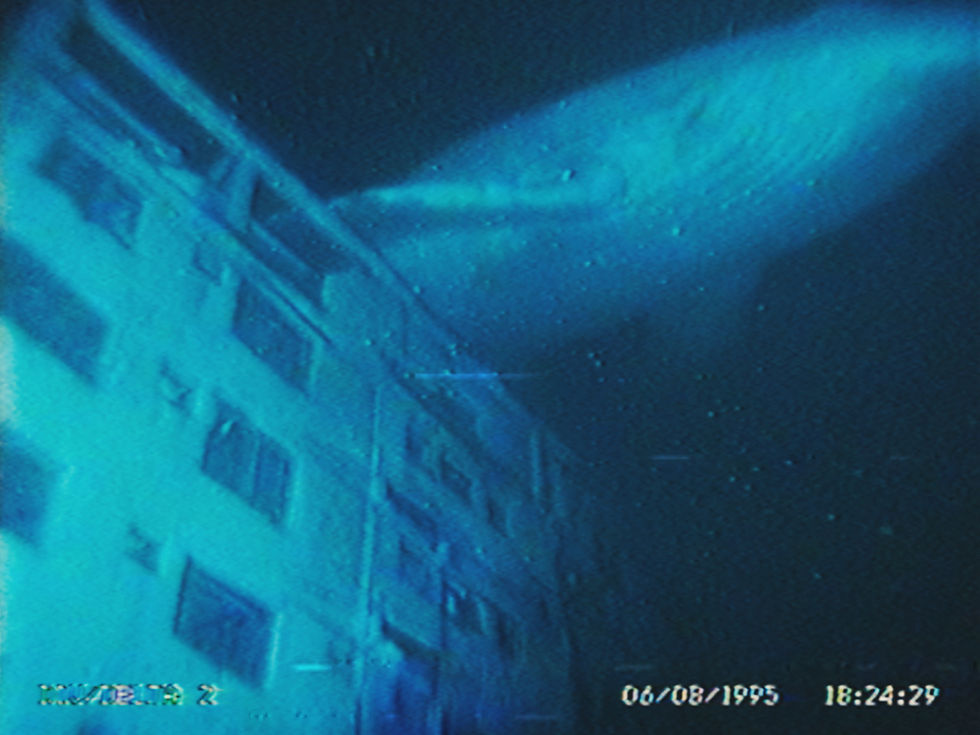
A photograph of a whale swimming above a submerged apartment complex in Episode 11 of The Mirror Without Image. Credit to Rapport Erebus.
12. How many installments do you currently have in The Mirror Without Image series, & how many do you intend to produce total? What is the future of The Mirror Without Image, & your work as a whole? (Note: This interview was conducted on September 16th, 2026.)
The last episode released was episode 17 (as of September 16th, 2026). The last episode of The Mirror Without Image will be episode 18. It should be really short, about 3 minutes. It will tie in the 2 timelines with a neat bow. It was a really big project when I started. I didn’t think it would take so much time; it’s a full-length movie. After episode 18, I will edit all the episodes together like I did for Rapport Erebus. It will be an hour & 12 minutes long movie. I did a full movie! I think I’m going to take a break after that.
For the next project, I will have to think about having producers or having people interested in financing it, because it’s a lot of work! I started it in March (2026), doing it in the mornings before work or evenings after work, doing double days almost every day. If it gains traction, people like it, & want more of it, & someone is interested in financing something like that, maybe.
I don’t know if I have the courage to do it as a personal project.
There’s a question that comes back in a lot of comments about whether I use AI or not. I was surprised that it was such a polarizing thing; I think it’s much less polarizing in France than it is in the US. I use a bit of AI, especially for The Mirror Without Image episodes with shadow people. For the 3D rendering, I use a little bit of DLSS 5 to re-texture the 3D to make it look more realistic. I know people are really polarized on this issue, but I have to say it; I have to be honest, because I don’t want to lie to people. It’s an issue that a lot of people have a problem with, so I wanted to be honest & address it. I think that the thing people need to understand is that it isn’t all there is. It’s not like I push a button, & a movie comes out. It doesn’t work like that at all. That’s not how I used it. I enjoy the comments speaking on the story, on theories, & things like that as opposed to more technical discussions. If people can forget the technical, focus, & be immersed in the world & in the story, that’s the biggest thing for me, to make them forget that they’re watching CGI. That’s my goal.

14. Across your work in oceanic horror, what has been your proudest moment or greatest triumph?
I think it’s being recognized by people I follow, for example, EmmortalMarcus. He’s an analog horror YouTuber. He does reviews & things like that. He reviewed Rapport Erebus, the first series, & gave a shout-out to the second one a few months ago. Seeing notifications about my work from people I follow on YouTube with my actual personal account, that’s a proud moment.
15. Across your time working in oceanic horror, I’m confident that you have encountered your fair share of hurdles & challenges. What is the largest challenge you’ve faced? How have you overcome it?
The challenge is to find time, & courage to do it. We have a lot of other things to do like taking out the trash, cooking, or cleaning your room. Finding time is really the hardest thing. You’ve just got to believe in your idea, & just go through it, even if you’re doubting. Remember that the people seeing your content for the first time might have the same emotion that you had when you had your idea! Even if you’re not satisfied, it’s better to release something than to not do anything at all.
At the end of Neon Genesis Evangelion (1995-1996), the hero Shinji doesn’t want to build relationships with people because he doesn’t want to get hurt. If you don’t want to get hurt, or face criticism, you’re paralyzed; you won’t be able to do anything. You need to throw yourself out there, & just do it! Even if some people criticize it, you might have pushback; push through & open yourself to the people. If they like it? Great! If they don’t? Well, too bad, but that’s life.
16. Do you have any advice for aspiring ocean horror authors, video creators, writers, or voice actors?
There’s a rapper in France called Orelsan; he had a punchline “If you want to make a film, you just need something to film it with”, That’s kind of the philosophy, especially towards young people. If you have time, if you live with your parents or something, learn Blender or After Effects. Pick up your phone & film a short film with it. Throw yourself, & just do it!
17. Do you have any final words about Rapport Erebus, The Mirror Without Image, analog horror, or the haunting beauty of the sea?
Go watch it! If you are scared of the ocean like me, & if you like horror movies, you have some series just for you on YouTube!

Directories / Credits
Strategic Partnerships
Reel Guppy Outdoors
SharkedSkooler
Marine Enthusiasts Podcast
Cash Daniels
Tides of Tomorrow
The Open Book, Topanga
Olivenbaum Music
Pitfire Artisan Pizza
Three J’s Kitchen
Presence News
Our Loyal Patrons
P. R. Ochoa


Comments